Algorithmic Trading Risk Management Recruitment: High-Stakes Talent for Systematic Desks

A risk manager who can't read your C++ production code is a liability, not a safeguard. Traditional algorithmic trading risk management recruitment often fails because it treats the function as a reporting layer rather than a technical engineering discipline. You likely find yourself discarding candidates who crumble when asked to explain tick-to-trade latency or the specific failure modes of exchange connectivity. It's frustrating to receive bank-style CVs when your desk requires someone who can build the very guardrails they monitor.
I've observed that the gap between a standard risk analyst and a true systematic risk engineer is widening as Chicago prop shops and London-based multi-manager platforms adopt more complex, AI-driven strategies. This article provides an insider view on sourcing talent capable of protecting alpha in high-frequency environments. I will outline how to vet for genuine technical depth and manage the friction of 12-month non-compete periods. I will also discuss securing hires who understand the underlying infrastructure of a systematic desk. Finding a professional who actually improves your Sharpe ratio through precise tail-risk management requires a search process as rigorous as the strategies they oversee.
Key Takeaways
- Modern risk managers must pass the same technical coding bars as quant developers to ensure they can audit production code in real time.
- Successful algorithmic trading risk management recruitment requires identifying candidates who understand low-latency infrastructure and exchange connectivity failure modes.
- Differentiate your search strategy based on fund structure, specifically addressing 12 to 18 per cent P&L splits for pod shops versus equity partnerships in proprietary firms.
- Minimise time-to-hire by mapping out potential spinouts and managing the long garden leave periods typical of elite systematic desks.
- I recommend using an operator-led vetting process to verify that a candidate's mathematical depth actually protects your alpha during tail-risk events.
The Evolution of Quantitative Risk in Systematic Trading
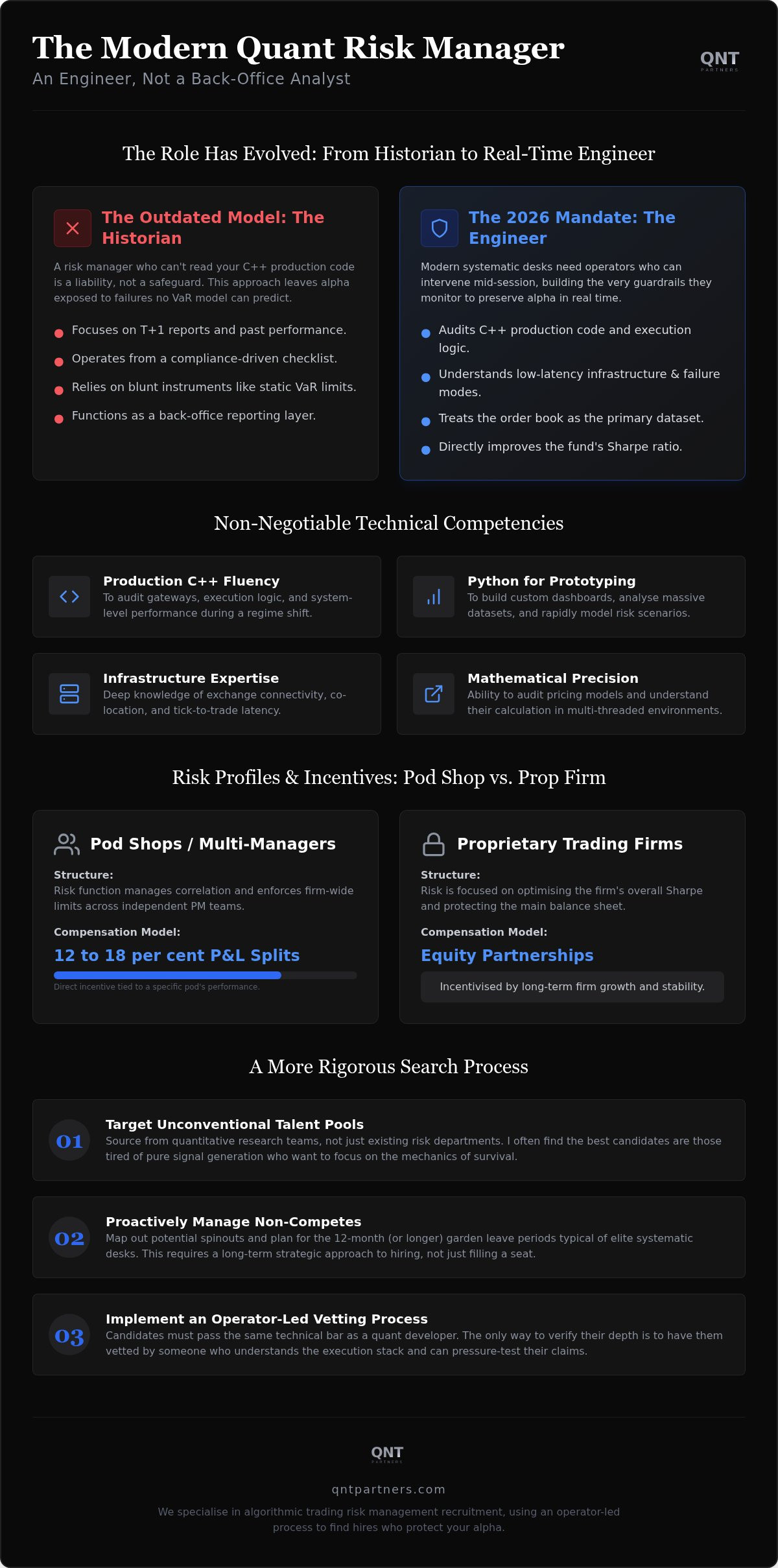
I've watched the risk function migrate from the back office to the heart of the execution stack. In 2026, a risk manager who only looks at T+1 reports is effectively a historian. Modern systematic desks need operators who can intervene in the middle of a trading session. This evolution has forced a total rethink of algorithmic trading risk management recruitment. If you are still hiring based on a compliance checklist, you are leaving your alpha exposed to infrastructure failures that no VaR model can predict.
The distinction between a researcher and a risk manager has blurred. If your risk hire cannot audit the alpha generation logic, they cannot protect it. I've seen too many firms treat risk as a secondary layer, only to realise their safeguards are useless when a strategy starts eating itself during a volatility spike. Alpha preservation now requires real-time monitoring of execution slippage and market microstructure. It is no longer about policing traders; it is about optimising the fund’s overall Sharpe ratio.
Moving away from the compliance mindset
Traditional risk mandates focus on regulatory capital and static Value at Risk (VaR) limits. These are blunt instruments. When conducting algorithmic trading risk management recruitment, I prioritise candidates who treat the order book as their primary dataset. They understand how a strategy's passive fills might turn toxic during a regime shift. This requires a shift from policing to optimisation. The goal is to prune uncompensated risk before it compounds. I often find these candidates hiding in quantitative research teams where they've grown tired of pure signal generation and want to focus on the mechanics of survival.
Effective risk managers at a Sydney-based systematic fund or a Chicago prop shop must understand how Algorithmic trading strategies interact with fragmented liquidity. They don't just report on breaches. They identify where the desk is taking on tail-risk that isn't reflected in the backtest. This level of insight requires an understanding of the underlying code and the exchange connectivity that facilitates the trade.
Risk as a real-time alpha preservation tool
Real-time alpha preservation is an engineering problem. It requires monitoring execution slippage at the microsecond level. A high-calibre risk hire identifies tail-risk events before they impact the P&L. They work alongside PMs to adjust position sizing based on live volatility rather than historical look-backs. I've seen firms succeed by integrating risk protocols directly into their C++ execution layers. This prevents the flash crash scenarios that occur when a rogue algo ignores soft limits. It is about building a system that can fail gracefully without wiping out a year of gains in ten minutes.
Collaborating with PMs to refine these guardrails ensures that risk management supports, rather than hinders, the pursuit of alpha. Integrating these protocols ensures that limits are hard-coded and latency-aware. You need someone who can build the guardrails they monitor. This technical depth is the only way to protect a desk from fat-finger errors and toxic flow in the same millisecond the trade is placed.
Technical Competencies for 2026 Risk Mandates
A modern risk hire must pass the same technical bar as a quant developer. If you are hiring someone who cannot step into a researcher's seat during a crisis, you are hiring a spectator. This reality is the cornerstone of effective algorithmic trading risk management recruitment. Proficiency in Python for rapid prototyping and C++ for system-level understanding is non-negotiable. I've seen funds lose millions because a risk manager could not spot a logic error in a production C++ gateway during a regime shift.
I've observed that the most successful systematic desks are those where the risk team can rewrite a gateway check if the latency profile shifts. You need people who treat the codebase as the single source of truth. If you need to discuss the technical benchmarks for your next risk hire, we can help define those requirements based on your specific stack.
Software engineering and mathematical precision
I look for the ability to audit complex pricing models directly in the production codebase. A risk manager should be building custom dashboards that handle millions of messages per second without dropping packets. It is not enough to understand the Greeks; they must understand how those Greeks are calculated in a multi-threaded environment. Statistical mastery of non-normal distributions and fat-tailed events is mandatory. The Federal Reserve's Financial Stability Report often highlights how automated systems can amplify market vulnerabilities. Your risk lead needs to understand the math behind these feedback loops to prevent your strategies from contributing to disorderly markets.
Infrastructure and exchange connectivity
Understanding tick-to-trade latency is essential for risk in HFT shops. You need a professional who knows how exchange protocols impact risk limits. If a risk check adds 500 nanoseconds to a trade path, they must be able to justify that latency cost against the protection it provides. Experience with FPGA or hardware-level risk checks is increasingly in demand for firms operating in the sub-microsecond space. I've found that the best candidates understand co-location dynamics and their effect on risk monitoring. They vet the resilience of the trading gateway with the same scrutiny as a lead engineer. They recognise that a blind spot in exchange connectivity is a direct threat to the fund's survival. If the risk check is co-located but the monitoring is in a different data centre, you have a structural vulnerability that needs addressing.
Risk Profiles in Pod Shops vs Proprietary Firms
I've found that the structural differences between a multi-manager platform and a proprietary trading firm dictate every aspect of the risk mandate. You cannot hire a risk manager for a pod shop using the same criteria you would use for a Chicago prop shop. This distinction is often missed in generic algorithmic trading risk management recruitment, leading to a mismatch in technical expectations and cultural fit. Structure dictates the personality and technical background required.
Multi-manager pod structures
In the pod shop environment, the risk manager acts as a referee between individual PM autonomy and firm-wide survival. They must handle the specific economics of the pod model, where PMs often operate with a 12 to 18 per cent P&L split. I've observed that the best hires for these roles possess the diplomatic weight to cut a PM's capital when drawdown limits are breached. They manage the tension of allocating capital across diverse, often competing, strategies while ensuring the firm's aggregate exposure remains within bounds.
This role requires a deep understanding of SMA structures and how individual strategy volatility aggregates at the fund level. The FMSB report on algorithmic trading challenges highlights the increasing complexity of model risk in these fragmented environments. Talent in this space must be able to verify that a new pod's signal isn't merely a correlated version of an existing strategy. They are capital allocators as much as they are risk controllers.
Proprietary trading and HFT models
Proprietary firms typically favour a centralised risk model with deeper infrastructure integration. Here, the risk manager is often the final gatekeeper for new strategy deployments. Their focus is on the firm's own capital and the long-term health of the shared infrastructure. I look for candidates who specialise in low-latency execution and hardware-based risk controls, such as FPGA-based pre-trade checks.
These firms require risk professionals who are comfortable auditing the tick-to-trade latency impact of every new safeguard. They don't just monitor limits; they vet the resilience of the trading gateway itself. In a prop shop, a risk manager is an extension of the engineering team. They ensure that a spinout from a larger firm doesn't bring legacy habits that could compromise the firm's co-location advantages. The focus is on technical precision and the ability to prevent catastrophic failure in sub-microsecond environments. Technical mastery is the only way to earn respect on these desks.
Sourcing Strategies for the 12-Month Non-Compete
The most capable risk professionals are almost never on the open market. If a candidate is actively applying to job boards with an "Open to Work" banner, they likely lack the specific technical depth required for a high-frequency environment. Effective algorithmic trading risk management recruitment relies on identifying talent while they are still tethered to a competitor. Specifically, you must target individuals who are halfway through a 12-month non-compete or serving out a garden leave period. These candidates are often the most valuable because they have already been vetted by elite firms.
The quiet period of a non-compete is the most critical window for engagement. This is when you build the rapport necessary to secure a hire who might otherwise be poached by a larger multi-manager platform. Managing the transition from a Chicago-based prop shop to a London systematic fund requires a deep understanding of local contractual norms. London courts typically enforce 6 to 12-month periods based on a reasonableness test. In contrast, Chicago firms often rely on aggressive buyout structures to move talent quickly. If you are struggling to map out these complex talent movements, you can contact us to discuss a search strategy.
Identifying talent during garden leave
We maintain a network that tracks the movement of key researchers and risk leads before their departures become public. You need to understand the specific non-compete clauses of major firms to time your approach correctly. Engaging with candidates during their quiet period allows you to discuss the technical roadmap of your desk without the pressure of an immediate start date. This builds the trust required to pull someone out of a stable environment into a new build-out or spinout. It is about being the first conversation they have after they hand in their resignation.
Structuring the offer for a long-term hire
A successful hire in algorithmic trading risk management recruitment requires an offer that reflects their status as a peer to the trading desk. You should balance immediate compensation with equity partnerships or P&L participation to align their interests with the fund's long-term Sharpe ratio. I've seen elite risk hires walk away from massive base salaries because the career trajectory into portfolio management wasn't clearly defined. Ensuring the hire feels like a peer from day one is essential. This means involving them in the same infrastructure discussions as your lead engineers and PMs. Structure your buyouts and sign-on bonuses to bridge the gap created by lost deferred compensation. This ensures the candidate is financially whole before they even step onto the floor.
The QNT Partners Approach to Risk Search
I've found that the only way to execute algorithmic trading risk management recruitment successfully is to function as an extension of your trading desk. We don't operate as a volume-based agency. Most recruiters treat risk as a checkbox. We treat it as a critical infrastructure component. Our vetting process is performed by former operators who understand Sharpe ratios and tick data. They know the difference between a theoretical VaR breach and a real-time liquidity crisis.
I prioritise the technical depth that generalist firms miss. If a candidate cannot explain the mathematical precision of their tail-risk models or the latency profile of their pre-trade checks, they don't make it to your inbox. This discreet, search-led approach is the only way to manage algorithmic trading risk management recruitment at the highest level. We focus on finding unheard-of talent in small spinouts and specific build-outs. Discreet and search-led. Absolute confidentiality.
Peer-level vetting for mathematical precision
Every candidate we present is evaluated on their ability to contribute directly to the strategy. I focus on the quality of the hire rather than the quantity of resumes. This peer-to-peer assessment ensures that a risk manager can audit production code and challenge a PM's assumptions during a drawdown. For a broader perspective on how we source these individuals, see our guide on Quant Trading Recruitment Firms.
Building your 2026 risk infrastructure
We provide strategic advisory on organisational talent structures for systematic funds. This includes defining the split between risk and engineering teams. We also facilitate capital raising and manager search through our SMA advisory. If you are planning a new desk or a firm-wide infrastructure overhaul, we can organise a confidential discussion about your next build-out.
I've seen funds fail because they hired a risk manager who was a spectator. Securing a hire who acts as a genuine safeguard for your alpha requires a search process that mirrors the complexity of the markets you trade. A technical failure on an HFT desk does not wait for a committee meeting.
Securing Technical Resilience for Systematic Desks
A risk function that cannot audit production code is a structural vulnerability. I've observed that the firms outperforming the market are those treating risk as a technical engineering discipline rather than a back-office reporting layer. This shift fundamentally changes the requirements for algorithmic trading risk management recruitment. You need professionals who understand tick-to-trade latency and exchange connectivity failure modes as intimately as your lead developers.
We specialise in identifying this technical talent within spinouts and smaller build-outs across global financial hubs. As a boutique firm founded by former industry operators, we prioritise the mathematical precision and technical depth required for HFT and systematic trading. We maintain the discretion necessary to engage elite talent during long garden leave periods. This ensures your desk remains protected without sacrificing the speed of execution.
If you are building out a new pod or refining your firm-wide risk infrastructure, I recommend a search process that values quality over volume. You can organise a confidential consultation with QNT Partners to discuss your specific mandates. Building a resilient desk starts with finding the people who can build the guardrails they monitor.
Frequently Asked Questions
What is the typical non-compete length for a quant risk manager?
Most elite firms enforce a 12-month non-compete for senior risk mandates. In London, courts usually uphold 6 to 12 months based on a reasonableness test. Chicago prop shops often match this but may offer more aggressive buyout structures for critical hires. Garden leave typically counts toward this period. You should expect a total out-of-market time of one year for any professional with exposure to sensitive execution logic or alpha signals.
How do P&L splits work for risk teams in multi-manager funds?
Risk professionals in multi-manager pod shops usually receive a discretionary bonus tied to the aggregate fund performance or a specific P&L slice of the pods they oversee. While PMs on these platforms often negotiate a 12 to 18 per cent P&L split, risk leads are compensated for their ability to prevent catastrophic drawdowns across the platform. This alignment ensures they prioritise the fund's survival over the aggressive expansion of a single pod's capital allocation.
Which programming languages are most in demand for quant risk roles?
C++ and Python are the non-negotiable standards for 2026 risk mandates. You need C++ for auditing the production execution stack and Python for rapid prototyping of tail-risk models. Candidates must be able to pass a technical screen that tests their ability to read multi-threaded code. I've found that firms specialising in low-latency execution also favour candidates with experience in hardware-level checks or FPGA integration to manage pre-trade risk without adding significant latency.
Can a quantitative risk manager transition into portfolio management?
Transitioning into portfolio management is a common career path for risk professionals who possess deep technical and mathematical precision. Many senior researchers move into risk roles to gain a broader view of the fund's aggregate exposure before spinning out their own pods. This trajectory is a key selling point during algorithmic trading risk management recruitment. It attracts talent who view risk as a tool for alpha optimisation rather than a purely defensive function.
How does SMA sourcing impact risk management recruitment?
SMA sourcing requires risk managers who understand the complexities of external capital mandates and specific investor constraints. When we facilitate capital raising through SMA structures, the risk lead must ensure that the strategy remains compliant with the investor's unique risk parameters. This requires a professional who can bridge the gap between internal trading logic and external reporting requirements. They must be comfortable discussing Sharpe ratios and drawdown limits directly with sophisticated institutional allocators.
What is the difference between market risk and model risk in HFT?
Market risk in HFT focuses on price fluctuations and fragmented liquidity across exchanges. Model risk is the threat of an algorithm's logic failing or behaving unpredictably during a regime shift. In high-frequency environments, model risk is often more catastrophic because an error can compound in microseconds. A risk manager must be able to audit the signal generation logic to identify where a strategy might turn toxic or ignore hard-coded safety guardrails during a flash crash.
Why should a systematic fund use a boutique search firm for risk roles?
Generalist firms often send candidates with bank-style compliance backgrounds who lack the technical depth for a systematic desk. We operate as a boutique firm of former industry operators who understand the mechanics of tick-to-trade latency and co-location. This peer-level vetting ensures that every candidate we present can actually read your C++ production code. We prioritise quality during algorithmic trading risk management recruitment to avoid the noise of generic agencies.
How do you vet the technical skills of a risk candidate?
We vet candidates through a combination of production-level coding screens and deep-dive mathematical assessments. A candidate must be able to explain the failure modes of their previous firm's risk infrastructure and suggest improvements to your current stack. I focus on their ability to build custom risk dashboards that process millions of messages per second. This operator-led approach verifies that the candidate possesses the technical precision to protect your alpha in high-frequency environments.