HFT Infrastructure Recruitment: The Definitive Reference for Elite Talent Acquisition

In ultra-low-latency environments, your infrastructure is not a support function; it is the strategy itself. While many firms struggle with talent leakage to big tech or the digital asset space, the most successful leaders recognize that elite performance requires more than just generalist C++ proficiency. The current landscape for hft infrastructure recruitment is defined by a scarcity of engineers who truly master kernel bypass, FPGA synthesis, and the nuances of micro-optimization. You've likely experienced the frustration of receiving candidates who lack the technical depth required for these high-stakes environments.
This guide serves as a definitive reference for identifying, vetting, and securing the specialized talent that drives competitive advantage. We'll explore strategic benchmarking for 2026 compensation, where top-tier firms are setting new standards for total rewards that often reach seven figures for high-performing staff. By moving beyond traditional keyword matching, you can access passive talent pools and significantly reduce the time-to-hire for critical infrastructure roles. We'll examine the methodologies used by industry operators to ensure your team structure remains resilient and technically superior in an evolving global market.
Key Takeaways
- Recognize why infrastructure has become the primary differentiator for alpha and how to shift your talent strategy to prioritize nanosecond-sensitive engineering mastery.
- Identify the critical technical nuances—from cache-locality and lock-free programming to RTL design—that distinguish elite hardware and software specialists.
- Understand why traditional keyword-based hft infrastructure recruitment fails and how an operator-led approach provides access to highly discreet, passive talent pools.
- Learn how to vet search partners by evaluating their technical literacy and their ability to navigate the secretive networks of top-tier systematic managers.
- Discover the benefits of integrating talent acquisition with capital advisory to build resilient, high-performance organizational structures.
The Strategic Imperative of HFT Infrastructure Recruitment in 2026
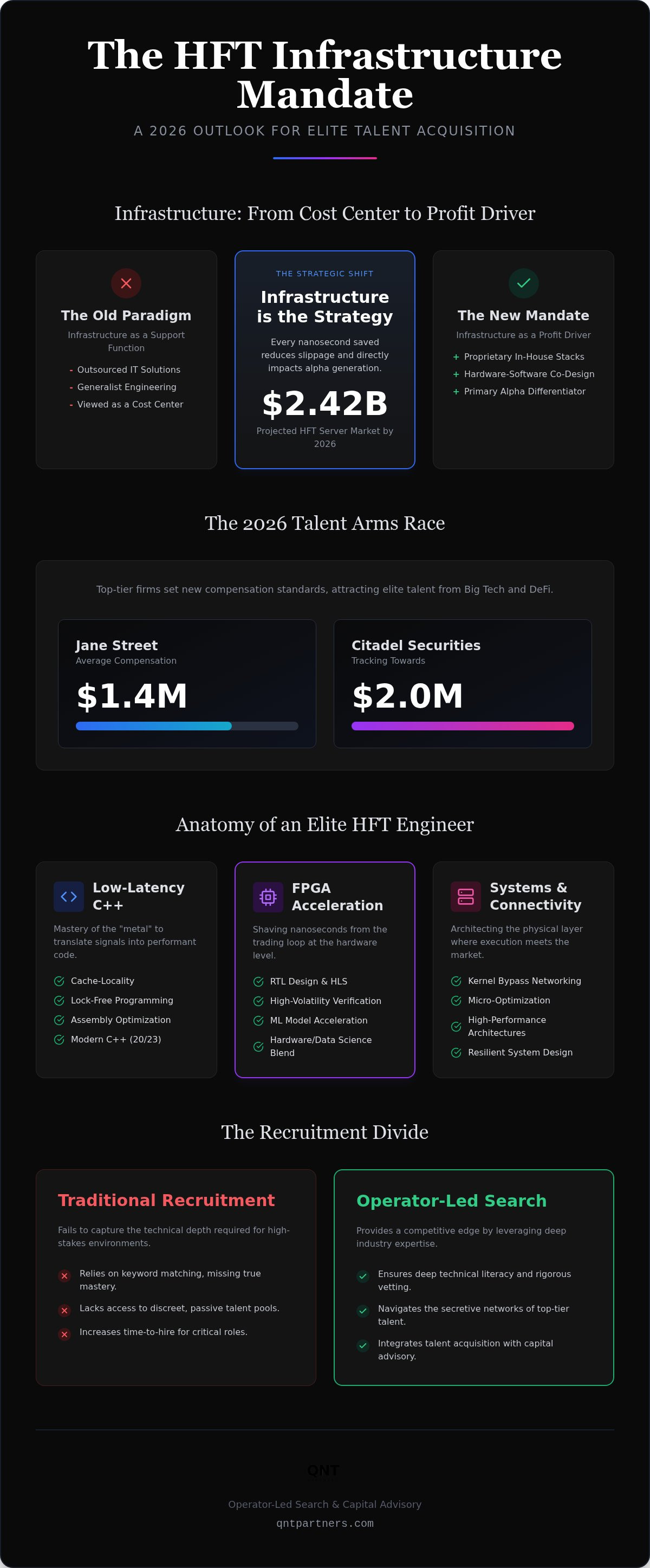
In the current market, hft infrastructure recruitment is defined as the strategic acquisition of elite engineering talent capable of architecting and maintaining nanosecond-sensitive trading environments. This is no longer a support function. As the HFT server market is projected to reach $2.42 billion in 2026, the focus has shifted from general software engineering to a rigorous hardware-software co-design model. For firms operating in High-Frequency Trading (HFT), the ability to secure specialists who bridge the gap between RTL design and low-latency C++ is the primary differentiator for alpha. Talent scarcity remains a critical bottleneck; the technical demands of ultra-low-latency execution require a level of mastery that few possess, directly impacting market liquidity and firm competitiveness.
Infrastructure as a Profit Driver
Low-latency engineering directly correlates to execution quality. Every nanosecond saved reduces slippage and ensures that signals are acted upon before the market moves. The modern Infrastructure Operator isn't a support staff member. They're a strategic partner who bridges the gap between quantitative research and market execution. Many leading firms have abandoned outsourced IT solutions in favor of proprietary, in-house tech stacks to maintain a competitive edge. This shift ensures that the underlying systems are perfectly tuned to the firm's specific strategies, transforming infrastructure from a cost center into a primary profit driver.
The 2026 HFT Talent Landscape
The competition for elite talent has intensified as HFT firms aggressively recruit from both Big Tech and decentralized finance. With average compensation at firms like Jane Street reaching $1.4 million and Citadel Securities tracking toward $2 million per head, the financial stakes have never been higher. We're seeing a rising demand for full-stack infrastructure specialists who operate at the hardware-software boundary, mastering both kernel bypass and FPGA synthesis. This expertise is rare, making hft infrastructure recruitment a high-stakes exercise in technical vetting and professional discretion. Infrastructure Alpha is the competitive edge gained through superior systems engineering that enables execution speeds unattainable by the broader market.
Core Specialisms in High-Frequency Technology Search
Effective hft infrastructure recruitment requires a departure from generic software engineering profiles. It demands a granular understanding of the hardware-software boundary. Specialists in this space aren't merely writing code; they're optimizing for the physical constraints of the machine. Success in elite talent acquisition depends on identifying candidates who possess a deep, operator-level mastery of specific technical niches that directly impact execution speed and system reliability.
Low-Latency C++ Mastery
C++ remains the industry standard for high-performance trading engines, yet the requirements have evolved significantly. It's no longer enough to understand syntax. We prioritize engineers who master cache-locality, lock-free programming, and sophisticated memory management. These developers must understand the "metal," demonstrating proficiency in assembly optimization and compiler behavior. The adoption of modern standards, specifically C++20 and C++23, is now essential for building scalable engines that can handle the data volumes expected in 2026. We often search for the "Quant Developer" hybrid, a role where technical execution meets mathematical intuition to translate complex signals into performant code.
FPGA and Hardware Acceleration
FPGA recruitment has moved from the periphery to the center of the trading stack. As firms look to shave nanoseconds off the trading loop, RTL design and High-Level Synthesis (HLS) have become critical competencies. We distinguish between FPGA Design Engineers who architect the core logic and Verification Specialists who ensure stability in high-volatility environments. A significant trend in 2026 is the intersection of hardware acceleration and artificial intelligence. Elite firms are increasingly hiring specialists to accelerate machine learning models on FPGAs for real-time signal processing, requiring a rare blend of hardware engineering and data science knowledge.
Systems and Connectivity Specialists
The systems layer is where execution meets the market. Mastery of kernel bypass technologies, such as Solarflare or Mellanox, is a mandatory requirement for these roles. Engineers must focus on interrupt handling and OS jitter reduction to maintain deterministic performance. Furthermore, the complexity of regulatory approaches to High Frequency Trading often dictates how these systems are architected across different global jurisdictions. Network architects now specialize in ultra-low-latency microwave and laser connectivity to secure the fastest paths between exchanges. For firms looking to solve these global connectivity challenges, partnering with an operator-led technology search firm provides the necessary access to engineers who have successfully managed these environments at scale.
Specialized Executive Search vs. Generalist Recruitment
Volume-based staffing models are fundamentally incompatible with the precision required for hft infrastructure recruitment. Generalist agencies often rely on automated keyword matching, a process that fails to distinguish between a standard C++ developer and an engineer capable of micro-optimizing cache-locality for nanosecond execution. This "CV spam" approach carries a high hidden cost; it dilutes the firm's brand in a small, secretive market and wastes hundreds of collective interview hours on candidates who lack the necessary technical depth. For HFT leaders, the goal isn't a high volume of applicants but a curated selection of vetted professionals who have already demonstrated mastery in high-stakes environments.
The Limitations of Volume-Based Staffing
Top-tier engineers, particularly those operating at firms where average compensation exceeds $1 million, rarely engage with generic LinkedIn outreach. They prioritize professional discretion and technical peerage. When a generalist recruiter fails to explain the nuances of interrupt handling or OS jitter, the candidate's interest evaporates instantly. This lack of technical literacy doesn't just result in failed searches; it signals a lack of sophistication that can permanently damage a firm's reputation among the elite technical community. Deep technical vetting must occur long before the first formal interview to respect the time of both the hiring manager and the candidate.
The QNT Partners Operator Advantage
QNT Partners operates as a strategic advisor rather than a traditional service provider. Our firm is led by former industry operators who speak the same language as the candidates we source. This "Peer-to-Peer" model ensures that every technical vetting session is conducted with the authority of someone who has managed these systems firsthand. We leverage global connectivity across London, New York, and Asia to access passive talent pools that remain invisible to generalist search firms. This unique access is critical in a landscape where firms like Jane Street and Citadel Securities are setting aggressive benchmarks for compensation and technical caliber.
Accessing elite talent requires precise market intelligence. In 2026, entry-level total compensation for software engineers at Hudson River Trading has reached an average of $400,000, while senior staff at Citadel Securities are tracking toward $2 million per head. We provide our clients with strategic benchmarking on base salary versus performance-based bonus structures, which often range from 50% to 200% of the base. High-stakes hiring in the systematic space demands absolute confidentiality. We manage the delicate balance of non-disclosure and professional gravity, ensuring that sensitive strategic shifts remain protected throughout the search process. This level of discretion is a hallmark of our quiet power in the international markets.
Vetting an HFT Infrastructure Recruitment Partner
Selecting a search partner in the ultra-low-latency space requires more than a review of past placements. It demands a rigorous assessment of their ability to operate as a technical peer. A partner's failure to grasp the nuances of your stack doesn't just result in poor hires; it actively degrades your reputation among the very engineers you seek to attract. When vetting a firm for hft infrastructure recruitment, you should follow a structured framework to ensure they possess the depth required for high-stakes talent acquisition.
- Technical Literacy: Can the recruiter articulate the difference between various kernel bypass implementations or explain why OS jitter reduction is critical for your specific desk?
- Network Depth: Do they have established, long-term relationships with "off-market" talent at secretive firms who aren't visible on public platforms?
- Strategic Alignment: Do they understand how your infrastructure choices, such as FPGA acceleration or microwave connectivity, directly support your alpha generation goals?
- Specialized Track Record: Can they demonstrate successful placements in highly niche roles like RTL design or low-latency C++ engineering?
- Professional Discretion: Is their commitment to confidentiality absolute, especially when handling sensitive strategic expansions?
Assessing Technical Literacy
Technical literacy is the first filter. A recruiter's inability to discuss cache-friendly code or the impact of memory management on deterministic execution is a significant red flag. You should ask specific questions about the HFT stack to test their depth. A strategic talent advisor understands the "metal" and can vet candidates before they ever reach your desk. This peer-to-peer engagement ensures that only the top 1% of talent is presented, respecting your time and organizational standards. If they can't explain why a candidate's assembly optimization skills matter, they aren't equipped to represent your firm.
Network Depth and Passive Sourcing
The most valuable infrastructure engineers are rarely active on job boards. They operate within a tight-knit inner circle where reputation and trust are the primary currencies. Specialized firms maintain these relationships over years, often engaging with elite researchers and engineers long before a specific role opens. This access to passive talent is what separates a generalist headhunter from a quiet power in the market. Strategic hft infrastructure recruitment relies on this deep-rooted connectivity to source candidates who can build nanosecond-sensitive environments. These candidates value discretion and only respond to recruiters who demonstrate genuine technical authority.
To secure the technical mastery required for high-frequency environments, you need a partner who understands the high-stakes nature of your business. If you are looking to optimize your organizational structure with elite engineering talent, consult with the operator-led advisors at QNT Partners to discuss your specific requirements.
QNT Partners: Operator-Led Search and Capital Advisory
QNT Partners functions as a boutique advisory firm where the search for technical excellence intersects with capital strategy. Our team is composed of former industry operators. This background allows us to operate with a level of professional gravity that generalist firms cannot replicate. We recognize that hft infrastructure recruitment is not an isolated function; it is a critical component of a broader organizational strategy that involves talent acquisition, capital allocation, and market positioning. When executing an hft infrastructure recruitment mandate, we prioritize technical competence and professional discretion above all else. By providing discreet executive search for the world's leading systematic managers, we ensure that our clients maintain their competitive edge through superior human capital.
The Synergy of Talent and Capital
In the high-stakes world of quantitative finance, the movement of elite talent is often dictated by the quality and stability of a firm's capital. Top-tier engineers and researchers gravitate toward environments backed by institutional-grade capital, such as Separately Managed Accounts (SMAs). We help emerging and established managers build the technical infrastructure required to meet institutional standards for manager selection, making them more attractive to sophisticated allocators. Our dual expertise in talent search and SMA capital sourcing allows us to bridge the gap between technical capability and capital growth. We understand how a robust engineering team serves as a primary proof point for potential investors during the capital raising process.
Strategic Talent Advisory
Our engagement with clients extends beyond individual placements to include comprehensive talent strategy advisory. We consult on organizational structures, helping firms scale their HFT teams while maintaining the lean, efficient flow required for ultra-low-latency operations. Through human capital benchmarking, we provide data-driven insights into market compensation and team composition. This ensures our clients remain the "employer of choice" for the technical elite. This strategic positioning is essential in a market where talent is the ultimate differentiator.
If you require a partner who understands the deep-rooted relationships and technical mastery necessary for success in the international markets, contact QNT Partners for a discreet consultation on your infrastructure talent needs. Our firm operates as a quiet power, providing the unique access and strategic insight required to build and fund world-class systematic trading organizations.
Securing the Future of Low-Latency Execution
The competitive landscape of 2026 demands more than just incremental speed; it requires a structural commitment to engineering mastery. As alpha continues to migrate toward the hardware-software boundary, the success of your firm depends on your ability to secure the rare specialists who understand the metal. Traditional, volume-based staffing models cannot navigate the discreet networks where this talent resides. Strategic hft infrastructure recruitment must be handled with the professional gravity and technical depth that only industry veterans can provide.
QNT Partners operates as a quiet power in this space, offering a unique blend of operator-led search and integrated capital advisory. We provide global access to passive, Tier 1 talent pools across major financial hubs, ensuring that every candidate is vetted by peers who have managed these systems firsthand. By aligning your talent strategy with institutional standards and capital allocation goals, you build a resilient organization capable of sustained market leadership. It's time to move beyond keyword matching and embrace a search partner that understands the high-stakes nature of your infrastructure.
Partner with QNT Partners for Elite HFT Infrastructure Search to secure the technical mastery your strategy demands.
Frequently Asked Questions
What is the difference between a quant developer and an HFT infrastructure engineer?
Quant developers typically operate at the intersection of mathematical signals and strategy implementation; they focus on translating research into code. In contrast, an HFT infrastructure engineer prioritizes the execution path and deterministic performance. Their work involves kernel bypass, interrupt handling, and managing the hardware-software boundary to ensure signals reach the exchange with minimal latency. While the roles overlap, the infrastructure specialist is responsible for the system's underlying speed and reliability.
How do HFT firms benchmark salaries for low-latency C++ developers in 2026?
Firms benchmark salaries by evaluating total compensation packages, where performance-based bonuses frequently range from 50% to 200% of the base. In 2026, entry-level software engineers at Hudson River Trading earn an average of $400,000. For senior low-latency C++ developers, benchmarks at firms like Jane Street or Citadel Securities often exceed $1 million. We assist clients by providing granular data on market rates to ensure their offers remain competitive against Tier 1 tech hubs.
Why is FPGA recruitment so difficult compared to standard software engineering?
FPGA recruitment is exceptionally challenging because it requires a rare synthesis of hardware engineering and financial domain expertise. Unlike standard software engineering, FPGA specialists must master RTL design and High-Level Synthesis within the constraints of a nanosecond-sensitive trading loop. The talent pool is extremely limited; most qualified candidates are already embedded in secretive firms. Identifying these passive professionals requires a search partner with established technical credibility and deep-rooted industry relationships.
What are the key technical skills required for HFT infrastructure roles?
Success in these roles requires mastery of low-latency C++ and an intimate understanding of the machine's "metal." Key competencies include kernel bypass technologies like Solarflare, OS jitter reduction, and lock-free programming. For hardware roles, proficiency in Verilog or SystemVerilog for FPGA synthesis is mandatory. Additionally, specialists must understand network protocols and high-performance routing to manage global exchange connectivity effectively. These skills ensure the system remains deterministic under high volatility.
How can a recruitment firm help with talent retention in the competitive HFT space?
A specialized firm assists with retention by ensuring that candidates are fundamentally aligned with the firm's long-term talent strategy and technical roadmap. We provide strategic benchmarking of market compensation and equity structures to help clients identify potential leakage points. By advising on organizational structures and cultural fit, we reduce the likelihood of talent moving to competitors. Retention begins with a precise search process that prioritizes stability and professional alignment over simple placement.
What is the typical timeline for an executive search in high-frequency trading?
The typical timeline for an executive search in this niche ranges from three to six months. This duration accounts for the rigorous technical vetting required and the complexities of navigating existing non-compete agreements. Given the high cost of a bad hire in a high-stakes environment, we prioritize precision over speed. Our hft infrastructure recruitment process involves multiple stages of evaluation to ensure that the candidate's technical mastery and professional discretion meet our clients' exacting standards.
How does QNT Partners vet candidates for deep technical roles?
We utilize a peer-to-peer vetting model led by former industry operators who have managed high-frequency systems firsthand. Our technical interviews move beyond basic syntax to explore cache-locality, assembly optimization, and compiler behavior. We evaluate a candidate's ability to solve complex infrastructure challenges in live, ultra-low-latency environments. This operator-led approach ensures that we only present the top 1% of talent, maintaining the high register of competence our clients expect from a boutique advisory firm.
Do you assist with international relocation for elite HFT talent?
Yes, we provide comprehensive support for international relocation across the US, London, and Asian markets. Global connectivity is a core component of our service, as elite talent often resides in diverse tech hubs or academic centers. We manage the logistical and professional nuances of moving high-performing engineers between jurisdictions, ensuring a seamless transition for both the firm and the candidate. This global reach is essential for securing the specialized expertise required for international trading desks.