HFT Talent Market Intelligence: Strategic Benchmarking for 2026

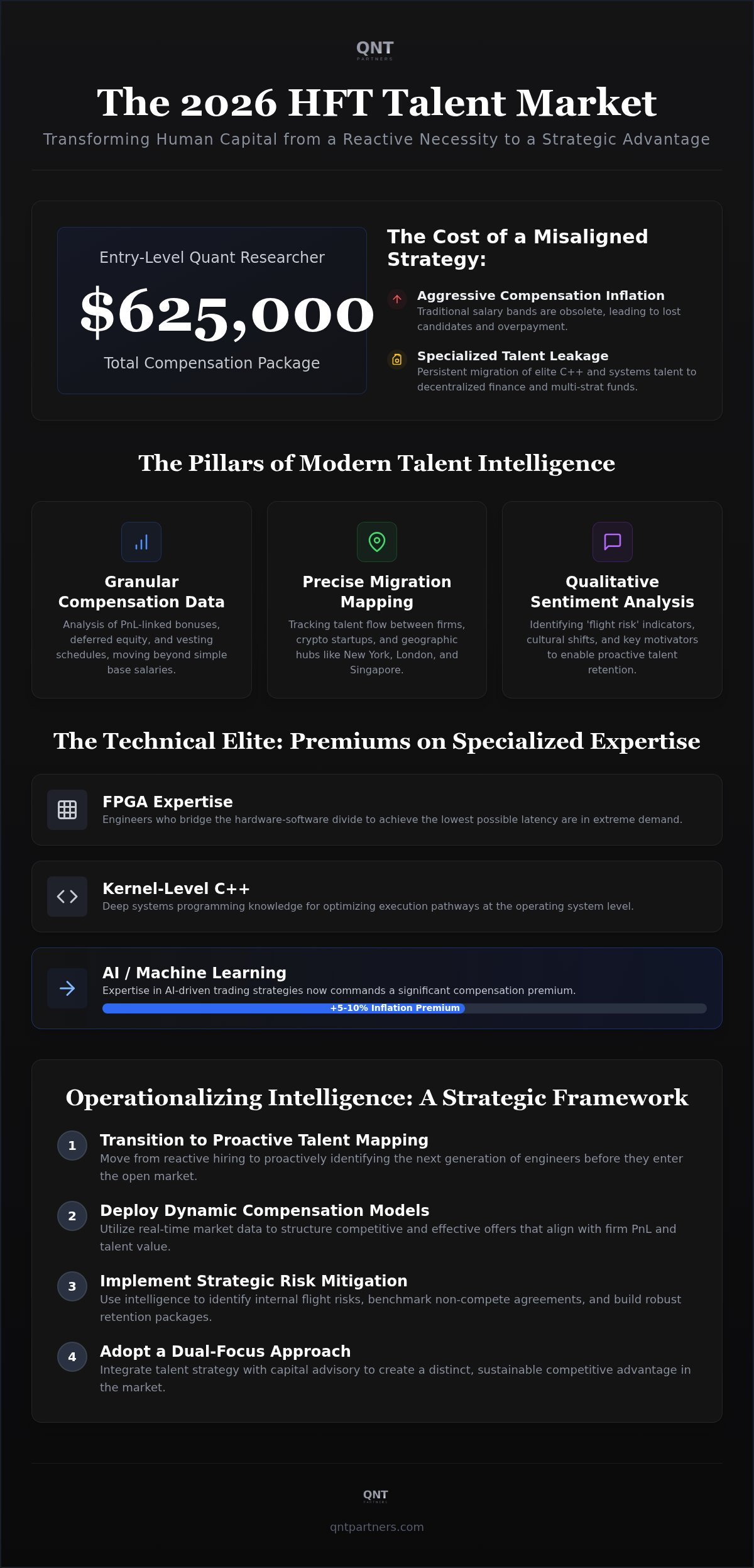
In the high-frequency trading arena, the most expensive latency isn't measured in microseconds; it's found in the months spent hunting for a lead FPGA engineer who's already been signed by a competitor. You're likely aware that the traditional recruitment playbook is failing against aggressive compensation inflation and the persistent leakage of specialized C++ talent to decentralized finance. With entry-level quant researchers now commanding total compensation packages reaching $625,000, the cost of a misaligned human capital strategy has never been higher.
This analysis provides the elite hft talent market intelligence required to transform your hiring from a reactive necessity into a strategic advantage. We offer a rigorous framework for mapping talent migration and establishing accurate compensation benchmarking for 2026. By examining the shift toward AI-driven roles and the rise of the independent specialist, we'll help you align human capital with technical infrastructure goals. This ensures your firm remains a quiet power in an increasingly crowded and data-driven market.
Key Takeaways
- Learn why modern hft talent market intelligence requires a synthesis of compensation data, sentiment analysis, and precise migration mapping to outperform the broader market.
- Understand the structural nuances of 2026 compensation, specifically the balance between PnL-linked bonuses and the escalating premium on FPGA and kernel-level C++ expertise.
- Analyze the 'revolving door' effect of elite professionals returning from crypto-native startups and the growing pressure multi-strategy hedge funds place on boutique talent pools.
- Discover a strategic framework for operationalizing intelligence through rigorous technical infrastructure gap analysis and the deployment of dynamic compensation models.
- Explore how a dual-focus approach on talent strategy and capital advisory provides a distinct competitive advantage for the quant trading elite.
The Paradigm Shift in HFT Talent Market Intelligence
In the ultra-competitive domain of High-frequency trading, the ability to execute a trade in nanoseconds is useless without the engineers who build the pipes. True hft talent market intelligence is the sophisticated synthesis of granular compensation data, qualitative sentiment analysis, and precise migration mapping. It moves beyond the surface-level metrics of general recruitment. Traditional KPIs, such as time-to-hire or basic salary bands, are increasingly insufficient for the 2026 landscape where entry-level total compensation for quant researchers can reach $625,000. The industry is witnessing a direct correlation between human capital density and firm-wide alpha generation. For the seasoned operator, intelligence isn't a back-office function; it's a tactical advantage in the war for low-latency talent. This intelligence allows firms to anticipate market movements before they manifest in competitor headcounts or public announcements.
The Limitations of Backward-Looking Data
Relying on 2025 data in a 2026 market is a recipe for strategic failure. The rapid evolution of FPGA applications and kernel-level C++ requirements means that last year's benchmarks are obsolete. Relying on self-reported candidate expectations often leads to overpayment or, worse, losing elite talent to firms with more accurate real-time data. Firms must transition from reactive hiring to proactive talent mapping. This involves identifying the next generation of engineers before they hit the open market. It's about knowing who is developing the next breakthrough in low-latency execution before their current employer realizes the value of the IP they're creating. In a market where ML expertise now commands a 5-10% inflation premium, static reports are a liability rather than an asset.
Intelligence as a Risk Mitigation Tool
Strategic intelligence serves as a critical shield against institutional decay. By identifying 'flight risk' indicators within systematic trading teams, firms can intervene before a mass exodus occurs. This requires benchmarking non-compete structures across global jurisdictions, especially as remote work blurs traditional geographic boundaries and regulatory environments shift. Protecting proprietary IP isn't just about legal contracts; it's about strategic talent retention. Understanding the specific motivators of your technical elite allows for the construction of retention packages that are both effective and respected. Effective hft talent market intelligence identifies when a competitor's culture is shifting or when their bonus pools are underperforming, creating a tactical opening to attract their top performers. This proactive stance is the only way to safeguard your infrastructure against talent leakage to big tech or aggressive multi-strat funds.
Core Pillars of HFT Market Intelligence: Beyond Basic Benchmarking
Effective hft talent market intelligence requires a granular understanding of compensation structures that go far beyond simple base salary comparisons. In the 2026 landscape, total compensation is increasingly weighted toward PnL-linked bonuses and sophisticated deferred equity instruments. These "golden handcuffs" are designed to protect proprietary alpha while ensuring long-term institutional stability. We observe a widening gap between firms that offer immediate liquidity and those that utilize multi-year vesting schedules to retain their technical elite. This methodology aligns with broader research into Strategic Workforce Development in finance, where the focus has shifted from mere headcount to the optimization of specialized technical capabilities. Firms seeking to refine their internal metrics often benefit from specialized talent strategy advisory to bridge the gap between data and execution.
Technical skill-set mapping reveals an extreme premium on FPGA and kernel-level C++ expertise. As execution speeds approach physical limits, the "hardware-software" divide has effectively vanished. Organizations are also re-evaluating geographic arbitrage. While New York remains a primary hub, Singapore and London offer distinct regulatory and tax advantages that are attracting senior researchers. Furthermore, the choice between flat and hierarchical research structures significantly impacts alpha generation. Flat models facilitate rapid iteration but often struggle with the institutional knowledge transfer necessary for scaling complex global strategies.
Quantifying the Intangibles: Firm Reputation and Culture
Prestige isn't just a vanity metric; it's a powerful recruitment lever in elite quant circles. Sentiment analysis of the "hidden" market often reveals more about a firm's health than its public PnL. We track how senior researcher retention is directly influenced by work-life balance and the perceived quality of the internal research environment. For professionals with 8+ years of experience, the ability to work on intellectually stimulating problems without the friction of legacy systems is often more valuable than a marginal increase in base pay. Measuring these intangibles allows firms to adjust their employer branding to attract the most discerning talent.
The Convergence of AI and HFT Infrastructure
The migration of LLM and generative AI specialists into systematic trading is a defining trend of 2026. These "AI-native" quant researchers command a compensation premium of 5-10% compared to traditional candidates. Benchmarking the cost of this talent is essential as machine learning moves from experimental signal generation to core execution roles. We're seeing a fundamental shift where traditional execution roles are being augmented or replaced by autonomous agents. Analyzing this shift helps firms anticipate the technical infrastructure required to support a modern, AI-integrated trading floor while managing the associated talent costs.
The Great Arbitrage: Talent Migration Trends in 2026
The movement of intellectual capital in 2026 is defined by a strategic "revolving door" between established trading firms and emerging technical sectors. We're seeing a significant volume of HFT professionals returning from crypto-native start-ups. These individuals often find that while the decentralized space offered high autonomy, it frequently lacked the robust execution infrastructure and capital stability of the traditional quant elite. This return to institutional frameworks is a core component of modern hft talent market intelligence, as firms must now benchmark their offers against the memory of aggressive, though often volatile, token-based upside.
Simultaneously, multi-strategy hedge funds are exerting unprecedented pressure on boutique HFT talent pools. These larger entities leverage their massive balance sheets to offer diversified risk profiles that boutiques struggle to match. This trend is particularly visible in the maturation of systematic macro strategies, which has shifted demand toward researchers who can navigate broader asset classes beyond high-frequency equity or futures execution. Geographically, the emergence of Dubai and Abu Dhabi as legitimate quant hubs is disrupting the traditional London-New York duopoly. The combination of zero-tax environments and proactive regulatory frameworks in the UAE has created a gravitational pull for senior talent looking to optimize their net compensation in a high-inflation global economy.
The Big Tech Exodus and the HFT Opportunity
Elite engineers are increasingly viewing the HFT sector as the premier destination for high-impact technical work, leading to a steady exodus from FAANG firms. In 2026, the allure of big tech has been dampened by corporate bureaucracy and slower innovation cycles. HFT firms are successfully poaching top-tier silicon engineers by matching or exceeding the deferred stock options common in the tech sector. Integrating these non-finance specialists requires a deliberate strategy. Successful firms focus on bridging the gap between pure hardware engineering and trading intuition, ensuring that a specialist in low-latency silicon can effectively contribute to alpha generation within their first six months. Benchmarking these "buy-out" costs is now a standard requirement for any firm serious about maintaining its technical edge.
Talent Leakage to Decentralised Finance (DeFi)
While many are returning to traditional firms, the HFT-to-DeFi pipeline remains a persistent threat to retention. The core drivers are no longer just ideological; they're structural. DeFi protocols offer equity and token-based compensation models that provide a level of direct ownership rarely found in traditional partnerships. To counter this leakage, firms are evolving their hft talent market intelligence to include more creative long-term incentive plans. Retaining alpha-generating researchers in 2026 requires a shift toward more transparent, performance-linked equity structures that mirror the upside potential of decentralized projects without the associated volatility of the broader crypto market.
Operationalising Intelligence: From Data Points to Talent Strategy
Transforming raw data into a functional competitive edge requires a methodical four-step approach. First, firms must conduct a rigorous gap analysis of their current technical infrastructure against their existing talent density. If your low-latency pipeline is targeting sub-microsecond execution but your FPGA engineering team is understaffed, your infrastructure goals are fundamentally at risk. Second, firms should implement dynamic compensation models. In 2026, static salary bands are a liability. Using hft talent market intelligence allows for real-time adjustments based on competitor bonus cycles and the rising cost of AI-native quants. This ensures you don't lose key personnel to a sudden mid-year market shift.
Third, develop a proactive headhunting map. This isn't about filling vacancies; it's about identifying the top 1% of talent in critical roles before they are active in the market. Finally, align your talent strategy with your capital-raising and SMA sourcing goals. For systematic managers, the ability to secure SMAs is directly tied to the caliber of the team. Investors aren't just buying an algorithm; they're buying the human capital capable of maintaining and evolving it in volatile conditions.
Building the 'Operator-Led' Talent Pipeline
High-frequency trading environments are too specialized for generalist recruiters. Effective intelligence requires advisors who have lived the "operator" reality and understand the high-stakes nature of the desk. Technical vetting must occur at the intelligence stage, ensuring that candidates possess the specific kernel-level C++ or hardware acceleration skills required. This discreet approach leverages global networks to identify individuals who wouldn't respond to traditional outreach. It's about finding the quiet powerhouses who are often settled but open to the right strategic move.
Strategic Scaling for Systematic Managers
Scaling a high-performance team requires more than just capital; it requires a blueprint for organizational structure. We benchmark speed-to-hire across global markets to help managers understand the lead times involved in building a new desk in London versus Singapore. By integrating talent advisory with capital advisory for SMAs, firms can ensure they have the right personnel to manage the assets they attract. This holistic view prevents the common pitfall of securing capital without the engineering capacity to deploy it. To begin refining your firm's approach, consider engaging with our talent strategy advisory services to build a data-driven recruitment roadmap.
Strategic Advisory for the Quant Elite: QNT Partners' Intelligence Framework
QNT Partners operates at the intersection of high-stakes execution and strategic human capital. As a firm founded by former industry operators, we understand that hft talent market intelligence is not a static report; it's a living tactical map. We serve the buy-side quant elite by providing more than just recruitment. Our dual focus on talent strategy and capital advisory via SMAs allows us to see the full picture of a firm's growth trajectory. This discreet operator persona ensures we speak the same language as CTOs and Heads of Research, commanding a level of respect that traditional search firms cannot replicate. We invite firms to engage for a bespoke diagnostic that identifies hidden vulnerabilities in their team structures.
The QNT Advantage: Depth, Discretion, and Global Reach
Our intelligence is rooted in deep international relationships across New York, London, Singapore, and emerging hubs like Abu Dhabi. We don't just track where talent goes; we understand why they move. This insight creates a unique synergy between executive search and SMA sourcing. When we optimize a systematic desk's talent structure, we're also positioning that manager to be more attractive to institutional capital. A recent internal review showed that firms aligning their technical hiring with specific infrastructure goals achieved significantly better integration of new AI-native quants. This depth of coverage ensures that our clients aren't just reacting to the market; they're shaping it.
Maintaining the Edge in 2026
The volatility of the 2026 ecosystem demands a partner that prioritizes precision over broad-market appeal. As technical requirements for low-latency C++ and FPGA engineering continue to tighten, the margin for error in hiring disappears. QNT Partners remains the preferred partner for firms that demand professional gravity and absolute discretion in their searches. We provide the clarity needed to navigate compensation inflation and the complexities of the "revolving door" between HFT and decentralized finance. To secure your firm's technical and financial future, explore our Strategic Talent Advisory framework.
Securing the Human Component of Alpha
The high-frequency trading landscape of 2026 demands a departure from reactive hiring. Success now hinges on the ability to synthesize compensation data with qualitative migration mapping. We've seen how the convergence of AI and low-latency infrastructure has created a new class of "AI-native" quants, and how geographic shifts toward hubs like Singapore and Abu Dhabi are redefining the talent pool. Relying on hft talent market intelligence is the only way to navigate these complexities without compromising your technical infrastructure goals or alpha generation potential.
QNT Partners provides the precision required for these high-stakes transitions. Our firm offers specialized expertise in HFT infrastructure and maintains a discreet global network of elite quant talent. As an operator-led advisory for systematic managers, we understand the nuances of the trading floor because we've lived them. We're ready to help you align your human capital with your long-term technical and capital-raising objectives.
Secure Your Firm's Talent Advantage with QNT Partners. The future of your trading desk starts with the strategic clarity we provide today.
Frequently Asked Questions
What is the primary driver of HFT talent migration in 2026?
The integration of generative AI and machine learning into core execution layers is the defining driver. This has created an intense demand for specialists who can bridge the gap between pure research and low-latency implementation. While the "revolving door" of professionals returning from crypto-native startups remains a factor, the 5-10% compensation inflation for AI-fluent roles defines the 2026 migration landscape. Firms must track these shifts to maintain technical density.
How often should HFT firms update their compensation benchmarks?
Firms should move toward real-time or at least semi-annual updates. Annual benchmarking is no longer sufficient in an environment where entry-level total compensation for quant researchers can reach $625,000. Static data from 2025 is effectively obsolete. Utilizing dynamic hft talent market intelligence allows managers to adjust offers based on competitor bonus cycles and sudden shifts in the big tech silicon engineering market, preventing talent leakage before it occurs.
What technical skills are commanding the highest premiums in HFT today?
FPGA and kernel-level C++ expertise command the most significant premiums. As firms approach the physical limits of execution speed, the hardware-software divide has vanished. Engineers capable of hardware acceleration and ultra-low latency optimization are in high demand. Additionally, AI-native quant researchers who can apply deep learning to signal generation are seeing substantial premiums. These specialized skills are the primary targets for aggressive poaching by multi-strategy hedge funds.
How does market intelligence assist in SMA sourcing and capital raising?
Institutional investors increasingly view human capital as a primary indicator of a firm's long-term viability. By utilizing hft talent market intelligence, systematic managers can demonstrate to institutional clients that they possess the technical density required to sustain alpha. This intelligence bridges the gap between talent strategy and capital raising. It provides a data-driven narrative that proves the firm can attract and retain the elite engineers necessary to manage specialized investment mandates.
Is HFT talent market intelligence useful for small boutique firms?
Boutique firms find this intelligence critical for survival against multi-strategy giants with massive balance sheets. Since boutiques have fewer roles to fill, every hiring decision carries higher institutional risk. Intelligence allows these firms to identify geographic arbitrage opportunities in hubs like Singapore or Dubai. It helps them craft bespoke compensation packages that emphasize intellectual autonomy and prestige, which are often more attractive to senior researchers than the bureaucracy of larger funds.
What are the common pitfalls of using generic recruitment data for HFT?
Generic data lacks the granularity required for the quant space. It often ignores the complexity of PnL-linked bonuses, carry, and multi-year deferred equity. Relying on self-reported candidate expectations or broad finance salary surveys leads to misaligned offers. Elite recruitment requires an operator's perspective to understand technical vetting and the "hidden" market sentiment. Without specialized intelligence, firms risk overpaying for mediocre talent or losing elite engineers to more informed competitors.
How do non-compete laws in different regions affect talent market intelligence?
Regional variations in non-compete enforcement create tactical windows for recruitment. Intelligence must map these legal structures across London, New York, and Singapore to determine the true "buy-out" cost of a candidate. As remote work becomes normalized, firms are increasingly hiring from jurisdictions with more favorable labor laws. Understanding these shifts allows managers to protect their own proprietary IP while strategically identifying talent that is legally able to transition between firms.
Can market intelligence help in identifying flight risks within quant teams?
Yes, intelligence identifies external indicators like competitor headhunting patterns and internal sentiment shifts. By monitoring the "hidden" market, firms can detect when their senior researchers are being targeted by aggressive multi-strat funds or DeFi protocols. This proactive approach allows for early intervention through adjusted retention packages or cultural shifts. Identifying these risks before they manifest as resignations is essential for protecting proprietary trading strategies and maintaining institutional stability.