How to Hire a Quantitative Researcher: The 2026 Institutional Guide

Understanding the Quantitative Researcher’s Mandate
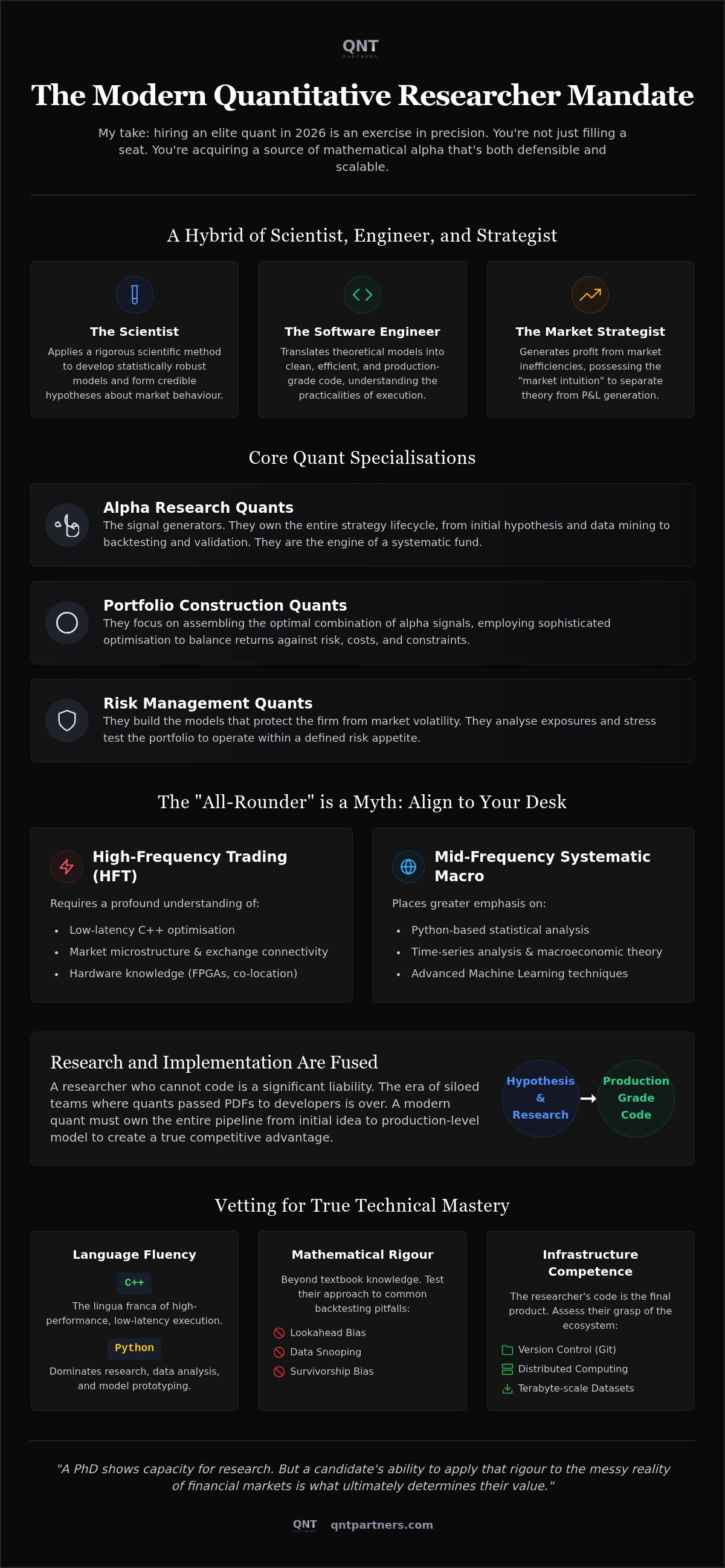
Hiring an elite quantitative researcher in 2026 is an exercise in precision. The objective is not merely to fill a seat, but to acquire a source of mathematical alpha that is both defensible and scalable. A modern quantitative researcher is a hybrid of scientist, software engineer, and market strategist. Their core mandate is to develop and implement statistically robust trading strategies that generate profit from market inefficiencies. This requires a deep understanding of data, a rigorous scientific method, and the technical skill to translate theoretical models into production-grade code.
The role is far from monolithic. It is essential to distinguish between the primary specialisations to align the hire with your fund’s specific needs:
- Alpha Research Quants are the signal generators. They are responsible for the entire lifecycle of a strategy, from initial hypothesis and data mining to backtesting and validation. Their work is the engine of a systematic fund.
- Portfolio Construction Quants focus on assembling the optimal combination of alpha signals. They employ sophisticated optimisation techniques to balance expected returns against risk factors, transaction costs, and portfolio constraints.
- Risk Management Quants build the models that protect the firm from market volatility and unforeseen events. They analyse portfolio exposures, conduct stress tests, and ensure that the fund operates within its defined risk appetite.
The evolution of this discipline has been rapid. Traditional econometric models have been augmented, and in many cases replaced, by advanced machine learning techniques. Expertise in deep learning and neural networks is no longer a niche skill but a core competency for many strategies. Consequently, the idea of a universal "all-rounder" quant is largely a myth. The technical requirements for a high-frequency trading (HFT) desk, which prioritises low-latency C++ and hardware knowledge, are fundamentally different from those of a mid-frequency systematic macro fund, where Python-based statistical analysis and economic intuition may be more critical. Aligning the role’s requirements with your trading frequency and strategy is the first step towards a successful hire.
The Distinction Between Research and Implementation
In the contemporary systematic trading environment, a researcher who cannot code is a significant liability. The era of siloed teams, where researchers passed PDF documents to developers for implementation, is over. The speed and complexity of modern markets demand a seamless transition from hypothesis to production. A quant must not only discover a signal but also understand the practicalities of its execution. This intersection of signal discovery and low-latency implementation is where true competitive advantage lies. When vetting a candidate, it is crucial to evaluate their ability to write clean, efficient, and scalable code. Their capacity to own the entire research pipeline, from initial idea to production-level model, is a direct indicator of their potential impact.
Role-Specific Requirements for Systematic Desks
The specific demands of your trading desk must dictate your hiring criteria. A candidate for a High-Frequency Trading (HFT) role requires a profound understanding of market microstructure, latency, and C++ optimisation. In contrast, a role in Mid-Frequency Systematic Macro may place a greater emphasis on time-series analysis, macroeconomic theory, and proficiency in Python's data science stack. Beyond technical skills, a crucial yet difficult-to-measure quality is "market intuition". This is the ability to form credible hypotheses about market behaviour that can be rigorously tested. It separates the academic theorist from the practitioner capable of generating PnL. Furthermore, experience in specific asset classes, whether Equities, FX, Commodities, or Crypto, is often non-negotiable, as each market possesses unique data structures and behavioural nuances.
Evaluating Technical Mastery: Mathematics and Coding
A rigorous evaluation of a candidate's technical capabilities is the cornerstone of the quant hiring process. The goal is to move beyond academic brainteasers and assess their ability to solve real-world financial problems under conditions of uncertainty. While a strong foundation in stochastic calculus, linear algebra, and statistical inference is a baseline expectation, true mastery is demonstrated through practical application.
Coding proficiency remains a critical hurdle. C++ and Python form the dual-language standard for the industry. C++ is the lingua franca of high-performance, low-latency execution, while Python dominates the landscape of research, data analysis, and model prototyping. A candidate must demonstrate fluency in the language most relevant to the role. In the domain of Machine Learning, the challenge is to vet for genuine predictive power. A hiring manager must be able to distinguish between candidates who can apply ML techniques to generate robust, out-of-sample results and those who simply use buzzwords or present overfitted models. The focus should always be on the candidate’s methodology for validation and bias mitigation.
Assessing Mathematical Rigour
True mathematical rigour extends beyond textbook knowledge. It involves a deep, intuitive understanding of how to separate signal from noise, particularly in non-stationary financial data. An effective interview process will test a candidate's approach to designing and interpreting backtests. You must probe their understanding of common pitfalls like lookahead bias, data snooping, and survivorship bias. How do they mitigate these issues? What are their preferred methods for cross-validation with time-series data? While a PhD in a niche mathematical or scientific discipline can signal a capacity for deep, independent research, it is their ability to apply that rigour to the messy reality of financial markets that ultimately determines their value.
Coding and Infrastructure Competence
In many quantitative roles, the researcher's code is the final product. Therefore, they must understand the ecosystem in which it operates. This includes a grasp of the underlying hardware, data structures, and network protocols that can impact strategy performance, especially in HFT. When vetting, look for evidence of clean, scalable, and maintainable code. Can they work effectively in a collaborative research environment using version control systems like Git? Assess their familiarity with modern data pipelines, distributed computing, and the realities of working with terabyte-scale datasets. A quant who appreciates the engineering challenges of implementation is exponentially more valuable than one who operates purely in the abstract.
The Quant Recruitment Lifecycle: From Sourcing to Selection
Securing elite quantitative talent requires a disciplined, multi-stage process that mirrors the rigour of quantitative research itself. It is a methodical search for a specific skillset, not a broad trawl of the job market. A successful framework can be broken down into five distinct phases.
- Phase 1: Defining the Mandate. Clearly articulate the technical "must-haves" versus the "nice-to-haves". Define the strategy, trading frequency, asset class, and required tech stack before the search begins.
- Phase 2: Mapping the Talent Landscape. The most valuable candidates are rarely found on public job boards. The search must involve a global mapping of talent at competitor funds, in adjacent industries like Big Tech, and within leading academic institutions.
- Phase 3: The Multi-Stage Interview. A comprehensive process should include technical screenings, peer-level deep dives, practical problem-solving sessions, and cultural fit assessments with senior leadership.
- Phase 4: The Research Project. A well-designed take-home project using historical data is the ultimate test. It allows you to evaluate a candidate’s research methodology, coding standards, and problem-solving approach in a realistic setting.
- Phase 5: Negotiation and Closing. In a highly competitive market, the final stage is critical. It involves constructing a compelling offer, navigating complex non-compete clauses, and managing the candidate's expectations to ensure a successful close.
Sourcing Passive Talent in a Discreet Market
The fundamental truth of this market is that the best quantitative researchers are almost never actively looking for a new role. They are well compensated, intellectually challenged, and often bound by significant deferred compensation and restrictive covenants. Accessing this passive talent pool requires deep-rooted industry relationships and a reputation for discretion. Effective headhunting is not about unsolicited emails; it is about leveraging a trusted network to engage with "under-the-radar" talent. This process demands a nuanced understanding of the ethics and logistics of approaching individuals at competitor firms, ensuring confidentiality and professionalism at every stage.
Structuring the Technical Interview
The technical interview must be designed to gauge genuine depth, not trivia recall. Involving current senior researchers in a peer-level discussion is one of the most effective ways to assess a candidate's practical knowledge and thought process. It is also vital to avoid "interview fatigue". High-demand candidates are often engaged in multiple processes simultaneously. A streamlined, efficient, and respectful process that minimises redundant stages can be a significant competitive advantage. During these interviews, be alert for red flags. A candidate who demonstrates an over-reliance on high-level libraries without understanding the underlying algorithms, or who cannot explain their reasoning from first principles, may lack the foundational depth required for a senior research role.
Navigating the Competitive Landscape: Retention and Culture
Hiring a top-tier quantitative researcher is only half the battle. In a market where talent is scarce and highly mobile, retention is a strategic imperative. The 2026 compensation reality extends far beyond a simple base salary and annual bonus. Top quants are evaluating opportunities holistically, weighing financial incentives against intellectual freedom and organisational culture.
Creating a "research-first" culture is paramount. This means providing researchers with the resources, data, and autonomy they need to pursue novel ideas. It involves fostering an environment of intellectual curiosity and collaboration, where rigorous debate is encouraged and failure is treated as a learning opportunity. Logistical factors like non-compete agreements and extended notice periods also play a significant role in the hiring timeline and must be factored into strategic planning. Perhaps the most powerful, yet often overlooked, retention lever is transparency. A clear and fair system for PnL attribution that directly links a researcher's contributions to their compensation creates a powerful sense of ownership and alignment with the firm's success.
Structuring Competitive Offers
A compelling offer must be carefully structured to compete with both rival hedge funds and the deep pockets of Big Tech. This means balancing significant immediate cash compensation with long-term incentives like partnership tracks, equity, or a share of the strategy's profits (carry). For many academic-minded quants, non-monetary incentives are equally important. The promise of "intellectual freedom", a budget for independent research, or the ability to publish non-sensitive findings can be a powerful differentiator. It is essential to benchmark compensation not just against direct competitors in the HFT space but also against the lucrative packages offered by leading AI labs and technology firms, which are increasingly competing for the same talent pool.
Building a Moat Around Your Talent
Preventing "talent leakage" to other funds, crypto startups, or tech giants requires a proactive approach to talent management. The organisational structure itself has a profound impact on researcher satisfaction. Flat hierarchies that minimise bureaucracy and give quants direct access to decision-makers are often more appealing than rigid, layered corporate structures. Providing a clear and attainable career path, from junior researcher to senior strategist and ultimately to a portfolio manager role, is a critical component of long-term retention. It demonstrates a commitment to an individual's professional growth and provides a compelling reason for them to build their career within your firm.
Scaling Alpha Through Strategic Human Capital Advisory
In the specialised world of systematic trading, recruitment cannot be a transactional service. Engaging an executive search firm should be viewed as a strategic advisory partnership. It is not about CV delivery; it is about acquiring the human capital necessary to achieve your fund’s long-term AUM and performance goals. The right partner provides more than just candidates. They offer critical market intelligence on compensation trends, organisational design, and competitor strategies. This advisory layer transforms talent acquisition from a reactive necessity into a proactive driver of growth.
At QNT Partners, we leverage our deep industry expertise to facilitate the movement of elite technical talent across the globe. We understand that hiring a key researcher is an investment in your firm's future alpha generation capabilities, and we approach every search with the strategic rigour it deserves.
The Operator Perspective in Recruitment
The primary challenge in technical recruitment is the information asymmetry between a generalist recruiter and a specialist candidate. This gap can only be bridged by having "insider" knowledge. Our team is composed of individuals with direct experience in the quantitative finance and technology sectors. This operator perspective is critical for accurately vetting technical roles and understanding the subtle cultural nuances of different trading desks. We act as a bridge between institutional leaders and the highly specialised technical talent they need to hire, ensuring that both technical requirements and cultural fit are perfectly aligned. This approach safeguards our clients' most valuable assets: their time and reputation in the tight-knit HFT community.
Partnering for Long-Term Growth
A single strategic hire can define a fund's trajectory for years. We partner with our clients to develop multi-year talent strategies that anticipate future needs and build a sustainable competitive advantage. Whether you are building a new systematic desk from scratch or searching for a niche specialist in reinforcement learning or natural language processing, our global network and technical expertise can provide the necessary leverage. We help you build the teams that build the alpha.
Consult with QNT Partners on your next strategic hire.
Frequently Asked Questions
What is the average lead time to hire a senior quantitative researcher?
For a senior, high-impact role, the process typically takes three to six months. This accounts for discreet sourcing of passive candidates, a multi-stage interview process, and navigating notice periods and non-compete agreements which can be lengthy.
Should I prioritise mathematical theory or coding ability when hiring a quant?
This is a false dichotomy in 2026. Both are non-negotiable. A candidate needs the mathematical rigour to develop sound theories and the coding ability to implement and test them robustly. For HFT roles, C++ proficiency is paramount; for mid-frequency, Python expertise is often more critical, but a deficit in either area is a major red flag.
How do I vet a candidate’s alpha-generation claims without seeing their previous code?
Focus on their research methodology. A well-designed case study or take-home project using a generic dataset is the best approach. Ask them to walk you through their process for hypothesis generation, feature engineering, backtesting, and validation. Probe their understanding of biases and how they would control for them. Their thought process is more revealing than their past PnL, which is often unverifiable.
What are the most common reasons quants decline offers from hedge funds?
Beyond compensation, the primary reasons are cultural. A lack of intellectual freedom, excessive bureaucracy, poor data or technology infrastructure, and a lack of clarity around PnL attribution are common deal-breakers. The top candidates are optimising for impact and growth, not just salary.
Is a PhD mandatory for a quantitative research role in 2026?
No, but it is highly correlated with the skills required. A PhD from a top-tier programme in a quantitative field (e.g., Physics, Maths, Computer Science) demonstrates the ability to conduct long-term, independent research. However, exceptional candidates with Bachelor's or Master's degrees who can demonstrate equivalent research ability and practical success should not be overlooked.
How do non-compete agreements affect the hiring process for quants?
They are a significant factor. Non-competes can range from six to 24 months and are increasingly enforced, especially by large funds. This "garden leave" period must be factored into the hiring timeline and can sometimes be bought out as part of the offer. Legal counsel is essential to navigate these complex agreements.
What is the difference between a Quant Researcher and a Quant Developer?
A Quant Researcher is primarily focused on alpha generation: discovering, backtesting, and validating trading signals. A Quant Developer (or Strat Engineer) is focused on building and optimising the infrastructure, tools, and libraries that researchers use. While the roles are distinct, there is significant overlap, and the best teams foster close collaboration between them.
How can a recruitment firm help with discreet headhunting in the HFT space?
A specialised firm acts as a confidential intermediary. They can approach high-value, passive candidates at competitor firms without revealing the client's identity until there is confirmed mutual interest. This protects the client's strategic plans and the candidate's current employment, which is essential in a small, interconnected industry.