Organizational Design for Quantitative Trading Firms: A 2026 Strategic Framework

In the 2026 high-frequency landscape, alpha is no longer just a product of superior mathematics. It's a byproduct of organizational architecture. Most fund founders and CTOs have realized that the traditional wall between machine learning researchers and low-latency C++ developers has become a structural liability that slows execution and fuels talent churn. When your researchers can't speak the language of your engineers, the resulting friction creates a vacuum that competitors and crypto platforms are eager to fill.
Effective organizational design for quantitative trading firms requires more than just hiring elite talent; it demands a technical framework where capital sourcing and engineering mastery are perfectly synchronized. This guide serves as a strategic reference for leaders who need to scale their firms while maintaining a technical edge in an AI-dominated market. We'll explore the shift toward integrated pod structures, the necessity of specialized technical recruitment, and the retention strategies required to keep senior researchers earning seven-figure compensation packages within your ecosystem.
Key Takeaways
- Modern organizational design for quantitative trading firms necessitates a transition from traditional seat-filling to the engineering of deeply integrated, cross-functional technical teams.
- Evaluate the trade-offs between the multi-manager pod model and centralized platforms to identify the structure that best mitigates research silos and accelerates model deployment.
- Use updated 2026 compensation data for NYC and London to benchmark your offers against the aggressive talent acquisition tactics of digital asset competitors.
- Apply the "Operator Test" to your talent strategy advisory to ensure your search partners can distinguish between surface-level credentials and true technical mastery.
- Synchronize your talent acquisition with strategic capital advisory to build a scalable model where elite researchers and SMA sourcing work in tandem.
The Evolution of Organizational Design in Quantitative Trading
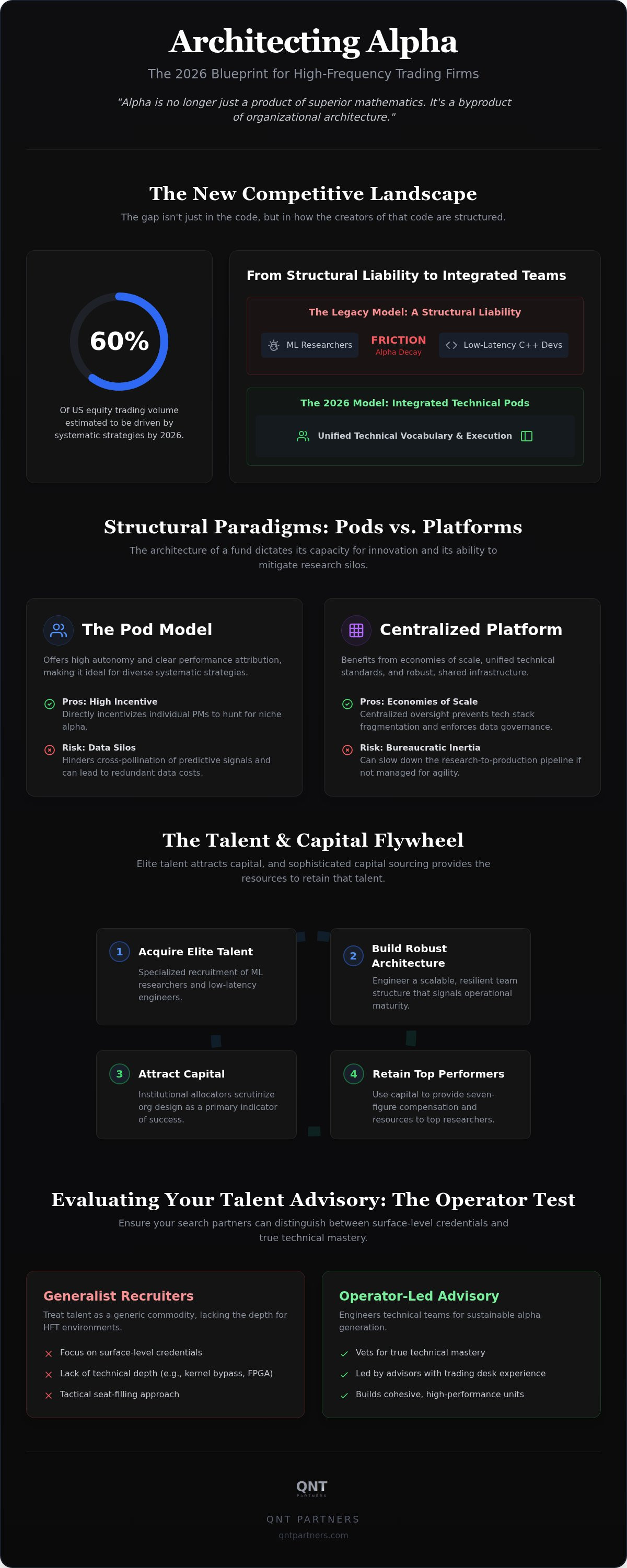
Organizational design for quantitative trading firms is the deliberate engineering of human capital to mirror a firm’s algorithmic execution objectives. It isn't a back-office administrative function; it's a front-office performance driver. By 2026, systematic strategies are estimated to drive over 60% of US equity trading volume. This dominance means that the competitive gap isn't just found in the code, but in how the creators of that code are structured. Modern firms are moving away from the legacy model of sourcing seats toward a model of engineering teams that function as a single, high-performance unit. Structural inefficiencies, such as research teams that operate in isolation from execution engineers, create latency in the model-to-market pipeline. This friction directly accelerates alpha decay, making specialized organizational consulting a critical necessity for systematic macro and HFT firms.
Beyond Tactical Headhunting: The Advisory Shift
Traditional recruitment models often fail in the high-stakes HFT environment because they treat talent as a generic commodity. Generalist recruiters lack the technical depth to distinguish between a standard developer and an elite low-latency C++ specialist who understands kernel bypass or FPGA integration. For ML-native firms, the requirement has shifted toward bespoke talent strategy advisory that prioritizes technical pedigree over broad market reach. Quantitative trading talent advisory is the engineering of technical teams for sustainable alpha. This operator-led approach moves away from simply filling desks toward building cohesive units where ML researchers and systems engineers share a unified technical vocabulary. It's about ensuring that the person vetting a candidate has actually sat on a trading desk and understands the nuances of the stack.
Talent Architecture as a Catalyst for Capital Allocation
Institutional allocators now scrutinize organizational architecture as much as they do historical Sharpe ratios. When vetting systematic managers, these allocators look for evidence of a scalable, resilient team structure that can survive the departure of a single key researcher. Robust talent architecture serves as a primary signal of operational maturity, directly impacting SMA sourcing success. By integrating talent strategy with capital raising advisory, firms can ensure their technical infrastructure is sophisticated enough to manage the increased complexity of external mandates. The relationship between technical infrastructure and capital sourcing is symbiotic; elite talent attracts capital, and sophisticated capital sourcing provides the resources to retain that talent. This alignment ensures that the firm’s growth is supported by a foundation of technical mastery rather than just marketing flair.
Structural Paradigms: Pods, Platforms, and Integrated Research
The architecture of a fund dictates its capacity for innovation. When considering organizational design for quantitative trading firms, founders must choose between the multi-manager "pod" model and a centralized platform approach. The pod model offers high autonomy and clear performance attribution, making it ideal for diverse systematic macro strategies. However, it often creates data-sharing silos that hinder the cross-pollination of predictive signals. In contrast, centralized platforms benefit from economies of scale and unified technical standards, though they risk bureaucratic inertia. For firms scaling in 2026, the challenge lies in selecting a framework that preserves the agility of a small team while leveraging the infrastructure of a mature institution.
The Pod Model vs. Centralised Research
Autonomous pods succeed by incentivizing individual portfolio managers to hunt for niche alpha. The primary risk is the fragmentation of the firm’s technical stack, which can lead to redundant data costs and incompatible codebases. The CTO’s role in a multi-manager environment evolves from a builder to a technical arbiter who enforces rigorous standards for data governance and backtesting. Without this centralized oversight, the "silo effect" prevents ML researchers from accessing the high-quality datasets necessary for training complex predictive models. Effective organizational design ensures that while pods operate independently, they remain tethered to a robust, shared infrastructure.
Designing for Low-Latency Synergy
The research-to-production pipeline is often where alpha is lost. In high-frequency environments, the interface between quantitative researchers using Python or R and C++ developers responsible for execution must be seamless. Friction here is a structural failure. Firms that integrate infrastructure teams directly into the research process reduce the time-to-market for new strategies. This synergy is critical for Scaling High-Performance Quantitative Trading Teams. By architecting teams that pair researchers with low-latency engineers from the project's inception, firms eliminate the costly "hand-off" phase where performance bottlenecks are typically discovered.
Discreet talent strategy advisory can assist founders in auditing these internal structures to identify where silos are compromising execution speed.
Strategic Human Capital Benchmarking for 2026
In the 2026 market, human capital is the most volatile asset class. For fund founders, organizational design for quantitative trading firms now requires a sophisticated understanding of real-time compensation shifts and the underlying drivers of talent mobility. Entry-level quants at top-tier firms like Jane Street or Citadel now command total compensation packages between $300,000 and $500,000. For mid-level researchers with three to seven years of experience, that range expands to $550,000 to $950,000. Senior partners and portfolio managers often exceed $3 million. These figures aren't just benchmarks; they're the baseline for survival in an environment where elite talent is frequently poached by digital asset firms offering aggressive token-based incentives and the promise of continuous liquidity layers.
Global talent pools are shifting. While NYC remains the epicenter for low-latency engineering, London and Hong Kong have emerged as dominant hubs for ML-native research teams. The move toward hybrid models has complicated retention; elite technical talent increasingly demands the flexibility of remote research environments balanced with the high-bandwidth collaboration of physical trading floors. Firms that fail to adapt their structural paradigms to these expectations face "talent leakage," a hidden cost that can erode a firm’s competitive edge faster than any market downturn.
Compensating for Alpha: Benchmarking Frameworks
Effective retention strategies have moved beyond the standard base-plus-bonus structure. To secure a technical edge, firms are implementing performance-linked payouts that align researcher incentives with long-term algorithmic stability rather than short-term PnL spikes. This shift is a core component of Human Capital Benchmarking for Quant Funds. By architecting compensation models that include deferred equity or participation in specific strategy tranches, firms create a "sticky" environment for senior researchers. This structural alignment is essential for mitigating the churn toward crypto competitors who leverage the tokenization of the settlement layer to offer more immediate, albeit riskier, upside.
Global Talent Intelligence
Acquiring "passive" talent in the HFT space requires more than a standard search; it requires deep-rooted industry relationships and the ability to track the movement of specialized research pods globally. These pods often move as single units, carrying with them proprietary methodologies and cohesive working cultures. Predictive modeling of future talent needs allows firms to identify gaps in their systematic strategies before they manifest as performance dips.
- London: High concentration of systematic macro and Bayesian modeling expertise.
- NYC: Dominance in ultra-low-latency C++ and hardware acceleration.
- Hong Kong: Rapid growth in AI-native Asian equity strategies.
Evaluating a Strategic Talent Advisory Partner
Selecting a partner for organizational design for quantitative trading firms is a strategic risk management decision that directly impacts a firm’s long-term alpha. Founders and CTOs shouldn't settle for intermediaries who lack the technical pedigree to understand their specific stack. The "Operator Test" serves as the primary filter for this selection: can the advisor engage in a peer-to-peer technical discussion with a head of research? If an advisor cannot articulate the nuances of kernel bypass or memory management in C++, they cannot effectively vet the engineers responsible for a firm’s low-latency edge. Rigor in the vetting methodology is especially critical for ML roles, where the distinction between a standard data scientist and an elite quantitative researcher lies in their ability to find signal in unstructured data under high-pressure market conditions.
The Five Pillars of a Quant Advisory Partner
A sophisticated advisory partner must demonstrate mastery across five core areas to be effective in the 2026 landscape. Technical literacy is the baseline; the advisor must understand the engineering challenges of systematic trading. Industry depth follows, requiring a clear grasp of how systematic macro strategies differ from HFT in terms of human capital requirements. Global reach is equally vital, as talent pools in NYC, London, Hong Kong, and Sydney each offer unique regional specializations. Furthermore, a partner must have proven access to discreet, non-active talent pools, reaching researchers who don't respond to traditional outreach. Finally, verifying the partner’s experience in SMA sourcing ensures they understand how team architecture influences capital allocation decisions.
Due Diligence on the Advisor
Founders should conduct rigorous due diligence on their advisory partners by reviewing their track record in placing "market-moving" talent. These are individuals or specialized pods whose arrival significantly enhances a firm’s technical capability or opens new geographic markets. Assessing an advisor’s commitment to discretion is also paramount; in a rarified industry, a partner’s market reputation is a reflection of the firms they represent. The most effective advisors provide a seamless synergy between talent search and capital advisory, ensuring that the human capital being recruited is directly aligned with the firm’s capital-raising goals. This integrated approach transforms recruitment from a cost center into a strategic catalyst for growth.
For founders seeking a peer-level relationship with advisors who have direct trading desk experience, exploring an operator-led advisory model is the most effective way to secure a technical advantage.
QNT Partners: The Operator-Led Advisory Model
QNT Partners operates at the precise intersection where human capital meets institutional liquidity. For fund founders, organizational design for quantitative trading firms is a multi-dimensional challenge that requires the strategic alignment of technical mastery with specific capital allocation goals. Our firm is built on the foundation of direct industry experience. We don't function as generalist recruiters; we are former operators who have managed trading desks and led technical engineering teams across global hubs. This background allows us to identify the subtle distinctions in technical competence that traditional firms often overlook, ensuring that every hire contributes to a cohesive, alpha-generating unit.
Where Talent Meets Capital
We bridge the critical gap between elite talent and capital sourcing. By connecting institutional investors with vetted systematic managers, we facilitate growth that is simultaneously technical and financial. Our structured advisory services support Institutional Allocation: SMA Sourcing, ensuring that the organizational structures we help architect are positioned to attract and manage significant external mandates. This synergy provides a dual advantage: firms gain the specialized talent required for alpha generation while securing the capital structures necessary to scale their operations globally. This integrated approach ensures that your firm’s growth is supported by a foundation of technical mastery rather than just marketing flair.
Building the Frontier of Quant Finance
As we approach the 2026 landscape, the competition for AI, ML, and predictive modeling experts will reach unprecedented levels. QNT Partners provides specialized search for these rarified roles, combined with strategic consulting on organizational talent structures. We operate with total discretion across NYC, London, Hong Kong, and Sydney, maintaining a level of formality that commands respect in the HFT and systematic macro sectors. Our focus remains on quality and technical precision, serving as a strategic advisor for firms that demand the highest level of professional competence and a partner who understands the high-stakes nature of the industry. Partner with QNT Partners for Strategic Talent Advisory to secure your firm’s technical edge.
Architecting for the Next Decade of Alpha
The landscape of 2026 demands that firm leadership views human capital not as an administrative hurdle, but as a core engineering challenge. Success requires moving beyond tactical hiring to implement a cohesive organizational design for quantitative trading firms that bridges the gap between research and execution. By benchmarking current compensation trends and eliminating structural silos, founders can build resilient ecosystems that attract both elite researchers and institutional capital. It's no longer enough to source individual contributors; you must engineer integrated teams that can withstand market volatility and aggressive talent competition from adjacent sectors.
QNT Partners provides the discreet, high-gravity advisory needed to navigate these transitions. Founded by former industry operators with direct trading desk experience, we offer global coverage across London, New York, Hong Kong, and Sydney. Our specialization in HFT, systematic macro, and ML-native sectors ensures that your talent strategy is as sophisticated as your algorithms. Secure your firm’s technical edge with QNT Partners’ strategic advisory. The future belongs to those who treat their team architecture with the same rigor as their trading models.
Frequently Asked Questions
What is the difference between a quant recruiter and a talent advisor?
A talent advisor provides strategic consulting on organizational design for quantitative trading firms rather than just filling seats. While a recruiter focuses on the immediate transaction of a hire, an advisor analyzes how a specific team structure impacts alpha generation. This includes auditing current technical stacks and advising on the alignment between human capital and capital sourcing goals. It's a shift from tactical headhunting to long-term architectural consulting that ensures technical teams are built for sustainable performance.
How do talent advisors benchmark compensation for HFT roles in 2026?
Advisors use real-time data from global hubs to track total compensation, which now includes base, performance-linked bonuses, and deferred equity. In 2026, entry-level quants at top firms earn between $300,000 and $500,000, while senior portfolio managers often exceed $3 million. Benchmarking also accounts for the aggressive token-based incentives offered by digital asset firms, ensuring that HFT offers remain competitive against crypto platforms and the high-liquidity layers of the modern settlement environment.
Why is an operator-led background important for quantitative recruitment?
An operator-led background ensures the advisor has direct trading desk experience, allowing them to vet technical mastery with peer-level authority. This perspective is vital for distinguishing between a standard developer and an elite low-latency specialist. Advisors who've managed risk or built trading infrastructure understand the nuances of kernel bypass and memory management. They can speak the same language as a CTO, which significantly reduces the risk of making a misaligned technical hire in a high-stakes environment.
Can a talent advisor help with SMA sourcing and capital raising?
Specialized advisors like QNT Partners integrate talent strategy with capital advisory services. This involves connecting institutional investors with vetted systematic managers and facilitating capital growth through structured SMA advisory. By aligning a firm’s organizational design with the requirements of institutional allocators, an advisor helps a fund demonstrate the operational maturity necessary to secure and manage large-scale Separately Managed Accounts effectively. This dual focus ensures that technical teams and capital sourcing are in perfect synchronization.
How does strategic advisory help in retaining elite ML research talent?
Strategic advisory focuses on building resilient environments through performance-linked payouts and integrated research structures. Retaining elite ML talent in 2026 requires more than high base salaries; it requires a culture that minimizes the friction between research and production. Advisors help firms architect hybrid models that balance remote research flexibility with high-bandwidth collaboration. This reduces the talent leakage often seen toward competitors or digital asset firms by ensuring researchers have a clear path to production and impact.
What are the key technical skills an advisor should vet for in systematic trading?
An advisor must vet for a combination of mathematical depth and systems engineering mastery. For researchers, this includes expertise in Bayesian modeling, neural networks, and finding signal in unstructured data. For engineers, the focus is on ultra-low-latency C++, FPGA integration, and kernel-level optimizations. Vetting these skills requires an advisor who understands how these technical components interact to maintain a firm’s competitive edge. It's about ensuring every team member possesses the technical pedigree required for high-frequency execution.
How do boutique firms like QNT Partners ensure discretion in executive search?
Discretion is maintained through a highly selective, network-driven approach that avoids public job boards and broad-market outreach. Boutique firms leverage deep-rooted industry relationships to access passive talent pools in a quiet, methodical manner. This approach ensures that sensitive searches for market-moving talent are conducted without alerting competitors. Every interaction is handled with professional gravity, prioritizing the reputation of both the client and the candidate while maintaining total operational security throughout the search process.
What role does AI play in modern quantitative talent advisory?
AI is used as a strategic tool for predictive modeling of talent needs and analyzing the movement patterns of specialized research pods globally. While AI assists in tracking compensation trends and identifying emerging systematic strategies, it doesn't replace the human judgment required to vet technical mastery. Modern organizational design for quantitative trading firms relies on AI for data-driven insights, yet the final assessment of a candidate's fit remains a peer-to-peer task handled by experienced industry operators.