Quantitative Finance Executive Search: Why Generalists Fail Systematic Funds

Generalist recruiters treat a low-latency C++ role like any other software engineering desk, ignoring the fact that a 500-nanosecond delay is the difference between alpha and a legacy system. If you are running a systematic fund, you've likely sat through dozens of interviews with candidates who look great on a database search but fail the moment you ask about exchange connectivity or tick-to-trade latency. This disconnect is why traditional quantitative finance executive search is failing the 2026 market.
I know how frustrating it is to waste your best researchers' time on candidates who don't understand how your P&L splits actually work or the nuances of a multi-manager structure. A simple keyword search doesn't capture the technical fit. You require a partner who has operated in these environments and understands why a PM at a Chicago prop shop might struggle in a Sydney-based systematic fund.
In this analysis, I will explain why an operator-led search beats database-driven recruitment in the 2026 quant market. I'll also cover strategic advice on handling 12-month garden leave periods and the shifting legalities of non-compete negotiations across different jurisdictions.
Key Takeaways
- Understand why generalist firms fail by ignoring the critical link between alpha decay and execution speed when filtering for technical talent.
- Learn how to vet candidates beyond the Sharpe ratio by focusing on tick-to-trade latency and exchange connectivity during the quantitative finance executive search process.
- Identify the differing hiring mandates between multi-manager pod shops and proprietary trading firms to ensure a better strategic fit.
- Manage the 12 to 18 month garden leave periods standard in 2026 with specific strategies for buy-outs and non-compete negotiations.
- Recognise the value of operator-led search partners who can speak the same language as your low-latency engineers regarding FPGA and C++ stacks.
The gap between generalist finance search and specialised quant recruitment
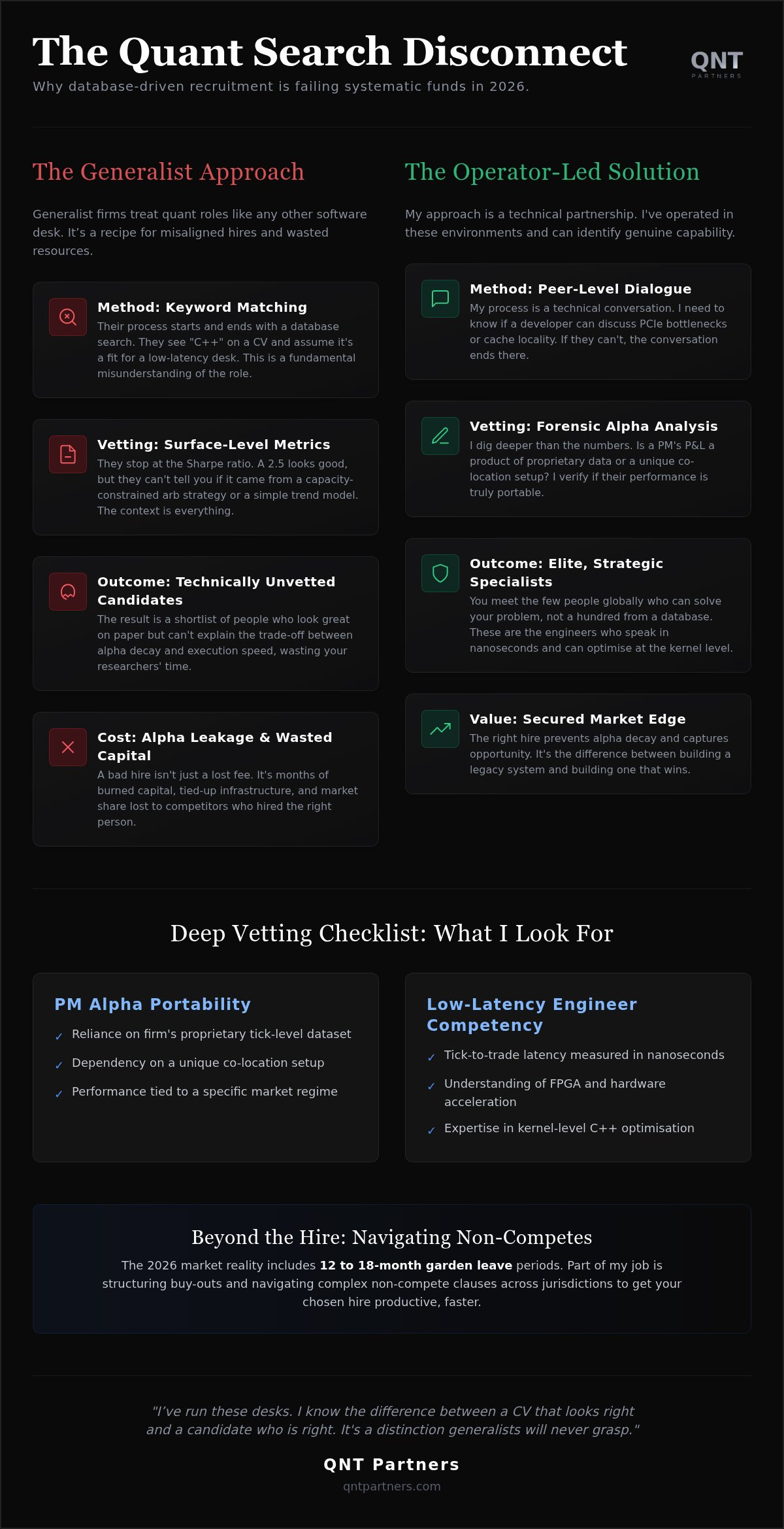
Most generalist firms treat a quantitative fund search like a standard mid-office finance mandate. They operate on the assumption that a database of 100,000 resumes guarantees a result. A fundamental misunderstanding. I've seen massive agencies pitch their global reach to systematic desks, only to deliver a shortlist of generic data scientists who can't explain the trade-off between alpha decay and execution speed.
Specialised quant search is a technical vetting process rather than a keyword matching exercise. If only five people globally can solve your specific low-latency problem, a database of a million generalists is useless. You need a partner who can identify those five through peer-level technical scrutiny, not a recruiter who thinks a Sharpe ratio is just a performance metric you find on a LinkedIn profile.
Why keyword matching fails for systematic desks
Generic recruiters see C++ on a CV and assume the candidate is a fit for a low-latency role. They don't realise the vast difference between application-level code and the systems-level engineering required for exchange connectivity. A researcher who spends their day building predictive models in Python might be brilliant, but if your strategy requires them to execute those models in a high-frequency environment, their lack of execution experience will be a bottleneck.
Peer-level vetting is the only way to avoid this. I've found that the best quants are often the ones who can walk through the underlying mathematics of their strategies from first principles. Simple as that. If a recruiter can't follow that conversation, they shouldn't be handling your quantitative finance executive search.
The cost of misaligned talent acquisition
Hiring the wrong Portfolio Manager is an expensive mistake that goes far beyond a lost recruitment fee. It burns capital and wastes expensive infrastructure resources while simultaneously creating alpha leakage. While you spend six months trying to fix a bad hire, your competitors are filling those roles with the right talent and capturing the market opportunity.
I remember a Chicago prop shop that lost significant market share because their hiring cycle for a lead FPGA engineer took nine months. They relied on a generalist firm that kept sending them application developers. By the time they found the right person, the specific arb opportunity they were targeting had been crowded out.
Technical vetting: Beyond the Sharpe ratio and the CV
I find that most recruiters stop at the Sharpe ratio. They see a 2.5 and stop asking questions. But a 2.5 in a capacity-constrained arbitrage strategy is fundamentally different from a 2.5 in a mid-frequency trend-following setup. When conducting a quantitative finance executive search, we have to look at the decay of that alpha and the specific market conditions where it was generated. I've seen researchers with stellar numbers fail in new environments because their previous success was a byproduct of a specific market regime that no longer exists.
I always investigate whether a PM's edge relies on a firm's proprietary tick-level dataset or a unique co-location setup that won't be available at a new fund to determine if their performance is truly portable. This distinction is vital. If the alpha is tied to a specific firm's internal infrastructure, the candidate will fail to replicate their success elsewhere. We verify this by digging into the signal construction and the latency profile of the trades during our vetting process.
Evaluating HFT infrastructure specialists
Finding elite engineering talent requires a deep understanding of FPGA and hardware acceleration. Low-latency C++ developers are performance specialists. They are not simply software engineers. They must build resilient exchange gateways that handle data bursts without introducing jitter. I look for developers who can discuss PCIe bottlenecks or cache locality without hesitation. If they can't speak to tick-to-trade latency in nanoseconds, they aren't the right fit for an HFT desk. I've seen cases where a Sydney-based systematic fund struggled for months because they hired generalist C++ coders who couldn't optimise at the kernel level.
The math behind the researcher
I find a massive gap between quants who merely use libraries and those who build the underlying algorithms. While deep learning is a major focus for alpha generation, traditional predictive modelling remains vital for many desks. I verify if a researcher understands how a specific neural network architecture actually processes features. This level of vetting ensures the candidate can innovate rather than just implement existing tools. A researcher who can't explain the gradient flow in their model is a liability in a high-stakes environment.
When we move talent of this calibre, the legal framework is always a factor. Even with the ongoing debates around the Non-Compete Clause Rule, most senior PMs are still bound by 12 to 18 month restrictions. Understanding these constraints is as important as the technical vetting itself. If you need to discuss how these technical nuances affect your next build-out, let's talk.
Pod shops vs. Prop shops: Comparing hiring mandates
A Portfolio Manager who thrives in a siloed pod structure is often a liability in a collaborative prop shop. These two environments require fundamentally different personalities and technical skill sets. I've seen researchers with brilliant track records fail simply because they moved from an environment where they owned the entire stack to one where they had to rely on shared infrastructure. Understanding these distinct Career Paths in Quantitative Finance is essential for building a desk that actually generates alpha.
Generalist firms often miss these nuances. They see a successful PM and assume the performance is portable without considering the risk limits or capital allocation models that supported them. A strategic quantitative finance executive search must account for the structural constraints of the hiring firm. If you are a multi-manager platform, you need talent that can survive a hard drawdown limit. If you are a prop shop, you might value a researcher who can improve the signals of three other desks.
Hiring for the multi-manager model
Pod shops prioritise PMs who can operate within brutal drawdown constraints. The focus is entirely on finding talent that can generate uncorrelated returns without blowing up. In this model, compensation is transparent. A 12 to 18 percent P&L split is the standard for senior talent, often with very little base salary relative to the upside. This structure attracts a specific type of mercenary talent. They don't care about the firm's overall success; they care about their specific book. For funds looking to scale through external capital, understanding SMA structures is just as important as the talent search itself.
Talent acquisition for proprietary desks
Proprietary trading firms often favour collaborative environments with shared infrastructure and research libraries. The mandate here is broader. You need quants who can collaborate across different strategies and engineers who can optimise the entire trading stack for the benefit of the whole firm. I've noticed that a Sydney-based systematic fund will often look for this hybrid profile. They need people who can bridge the gap between pure research and execution. The compensation here often includes equity or discretionary bonuses based on firm-wide performance, which appeals to those looking for long-term stability rather than just a P&L split. Identifying which environment a specific candidate will thrive in is the primary value I provide as a partner.
Managing the non-compete deadlock and garden leave
A 12 to 18 month garden leave is the baseline for senior talent in 2026. This is no longer an outlier. It's a strategic bottleneck that can derail a build-out before it even starts. If you're looking to hire a lead researcher from a Sydney-based systematic fund, you need to account for a full year of them sitting on the sidelines. I've seen too many firms treat this as an afterthought, only to have the deal collapse when the buyout numbers don't add up.
Strategic talent advisory is about planning for these lead times. We work with firms to map out their hiring needs 18 months in advance. This foresight allows for the movement of talent without the desperation that leads to overpaying for buy-outs. It's a technical chess game where the quantitative finance executive search partner must understand the specific non-compete triggers in each contract.
Negotiating the exit and the entry
The search partner acts as a critical mediator between the old firm and the new one. I find that direct negotiations between competitors often turn personal, which helps no one. We specialise in finding the middle ground where a reduced non-compete period is traded for specific carve-outs or financial settlements. Understanding the legal nuances between London and New York is vital here. UK courts are increasingly reluctant to enforce lengthy restrictions, while US states like Virginia and Washington have introduced specific salary thresholds for enforceability. You can find more detail on these hurdles in our analysis of Challenges in Hiring Quantitative Talent.
Planning for the sit-out period
The risk of talent becoming obsolete during a long sit-out is a genuine concern, particularly for HFT firms. A low-latency engineer who doesn't touch a codebase for 15 months loses their edge. We advise firms on how to maintain engagement with a candidate during their garden leave through educational stipends or technical briefings. Structuring compensation to account for lost P&L is equally complex. You have to bridge the gap between their previous P&L split and the future guarantee. Failing to manage this period properly often results in the candidate getting cold feet or being poached by a third party during their final months of leave. If you are struggling with a specific non-compete deadlock, contact us for a strategic consultation.
Choosing a search partner: The operator advantage
A recruiter who has never managed a risk limit or debugged a kernel bypass cannot effectively vet your next lead engineer. I've seen generalist firms attempt to fill FPGA roles by matching keywords on a CV without understanding the difference between RTL design and high-level synthesis. This ignorance is costly. When you select a partner for a quantitative finance executive search, you are choosing the person who will represent your firm's technical culture to the most elite talent globally. If they can't speak the language, they won't get the meeting.
The best partners act as an extension of your trading desk. We don't just send CVs; we provide strategic talent advisory that informs your build-out strategy. This means understanding your technical stack, whether you are running a C++ low-latency environment or a Python-heavy research desk. You need a partner who understands why your specific exchange connectivity requires a performance specialist rather than a general software developer. Someone who knows that a 200-nanosecond improvement is a structural advantage.
Why technical peer-level communication matters
Elite candidates only respond to recruiters who speak their language. I've found that a Portfolio Manager or a Senior Researcher is far more likely to engage when the initial reach-out includes a nuanced discussion of their strategy's capacity or the specific constraints of their current P&L split. An operator can pitch the technical challenges of your firm more effectively because they have faced those same challenges themselves. You can learn more about our background as operators on the QNT Partners Firm page.
The future of quant search in 2026
The 2026 market for quantitative finance executive search is shifting toward smaller, more specialised boutique firms for senior mandates. The era of the massive, generalist recruitment agency is ending for systematic funds. We are seeing a trend where talent strategy and SMA sourcing are merging into a single advisory service for emerging managers and spinouts. This allows firms to solve for both capital and talent simultaneously, creating a more efficient path to launch.
Hiring is an engineering problem. It requires the same precision, technical vetting, and strategic planning as building a low-latency trading stack. If you treat recruitment as a sales exercise, you will continue to struggle with poor technical fit and talent leakage. Professionalise the process and you will secure the alpha-generating talent your fund requires.
Professionalising your technical talent strategy
Generalist recruitment methods fail because they ignore the engineering reality of systematic trading. I've seen funds lose millions in opportunity cost simply because their partner couldn't distinguish between a researcher and an implementer. To build a desk that scales, you must move beyond keyword matching and embrace a peer-level vetting process that accounts for structural fit and alpha portability. Treating your hiring pipeline as a technical engineering problem is the only way to maintain a competitive edge in 2026. Simple as that.
Effective quantitative finance executive search requires an operator's perspective. We use our experience as former industry professionals to manage the 12 to 18 month lead times of garden leave while ensuring your technical stack aligns with candidate expertise. With a global network spanning Chicago, London, and Sydney, we focus exclusively on HFT and systematic trading mandates. We understand the mechanics of P&L splits and the nuances of pod structures because we've lived them.
It's time to stop wasting your PMs' time on interviews with poor technical fit. Partner with QNT for your next technical build-out. I look forward to helping you secure the elite talent your fund requires to thrive.
Frequently Asked Questions
What is the difference between retained and contingent search in quant finance?
Retained search is an exclusive engagement where we partner closely with a fund for senior mandates, whereas contingent search is a non-exclusive model. I find that retained search works best for critical alpha-generating roles because it guarantees dedicated resources and a deeper market mapping. Contingent search is better suited for high-volume hiring where the technical requirements are less niche. Most systematic funds prefer the retained model for PM hires to ensure professional discretion.
How much does a quantitative finance executive search typically cost?
Fees for a quantitative finance executive search are traditionally calculated as a percentage of the candidate's total first-year cash compensation. This includes the base salary and any guaranteed bonuses or sign-on payments. While industry standards vary based on the seniority of the role and the complexity of the technical vetting required, these agreements are usually structured as either a success-based fee or a staggered payment schedule for retained mandates.
What is a typical P&L split for a portfolio manager at a pod shop in 2026?
I see most senior PMs at multi-manager platforms negotiating a 12 to 18 percent P&L split in the 2026 market. This is the standard for those with a proven, portable track record. Some smaller shops might push this higher to 20 percent if the PM brings their own IP or an established team. These splits are often coupled with tight drawdown limits that can trigger a capital reduction if performance dips below a specific threshold.
How long is the average garden leave for a senior quant researcher?
A 12 to 18 month garden leave is now the standard for senior researchers and PMs at top-tier funds. I've noticed firms becoming more aggressive with these periods to protect their intellectual property and prevent alpha leakage. Managing this transition requires a strategic approach to buy-outs and non-compete negotiations. If you are moving between a Chicago prop shop and a Sydney-based fund, you should expect to sit out for at least a full year.
Can a search firm help with SMA sourcing for a new trading desk?
We facilitate SMA sourcing and capital raising as a core part of our advisory service for new desks and spinouts. I find that connecting a talented PM with the right institutional capital is just as important as finding the traders themselves. This integrated approach allows a new fund to solve for both human capital and investment capital simultaneously. It's a strategic advantage that traditional recruitment firms simply cannot offer.
Why do HFT firms prefer specialised headhunters over internal HR teams?
Internal HR teams often struggle to distinguish between a generalist software engineer and a low-latency performance specialist. HFT firms prefer specialised headhunters because we speak the same language as their traders and engineers. I can discuss tick-to-trade latency or FPGA bottlenecks with a candidate in a way that a generalist recruiter cannot. This peer-level vetting saves the trading desk dozens of hours in wasted interviews with poor technical fits.
What technical skills are most in demand for quant researchers right now?
Low-latency C++ and FPGA engineering remain the most critical skills for HFT infrastructure, while AI and ML specialists are in high demand for predictive modelling. I'm seeing a significant shift toward researchers who understand the underlying mathematics of neural networks rather than just using standard libraries. Candidates who can bridge the gap between pure research and execution are the ones securing the highest P&L splits and equity partnerships in 2026.
How do you verify the track record of a systematic trader?
Verifying a track record requires a deep dive into the portability of the alpha and the specific market regimes where it was generated. I look at whether the performance was dependent on a previous firm's proprietary data or a unique co-location setup. We also analyse the signal construction and the Sharpe ratio in the context of the strategy's capacity. This ensures the candidate can actually replicate their success in a new environment.