Strategic Manager Search for Family Offices: Sourcing Systematic Alpha

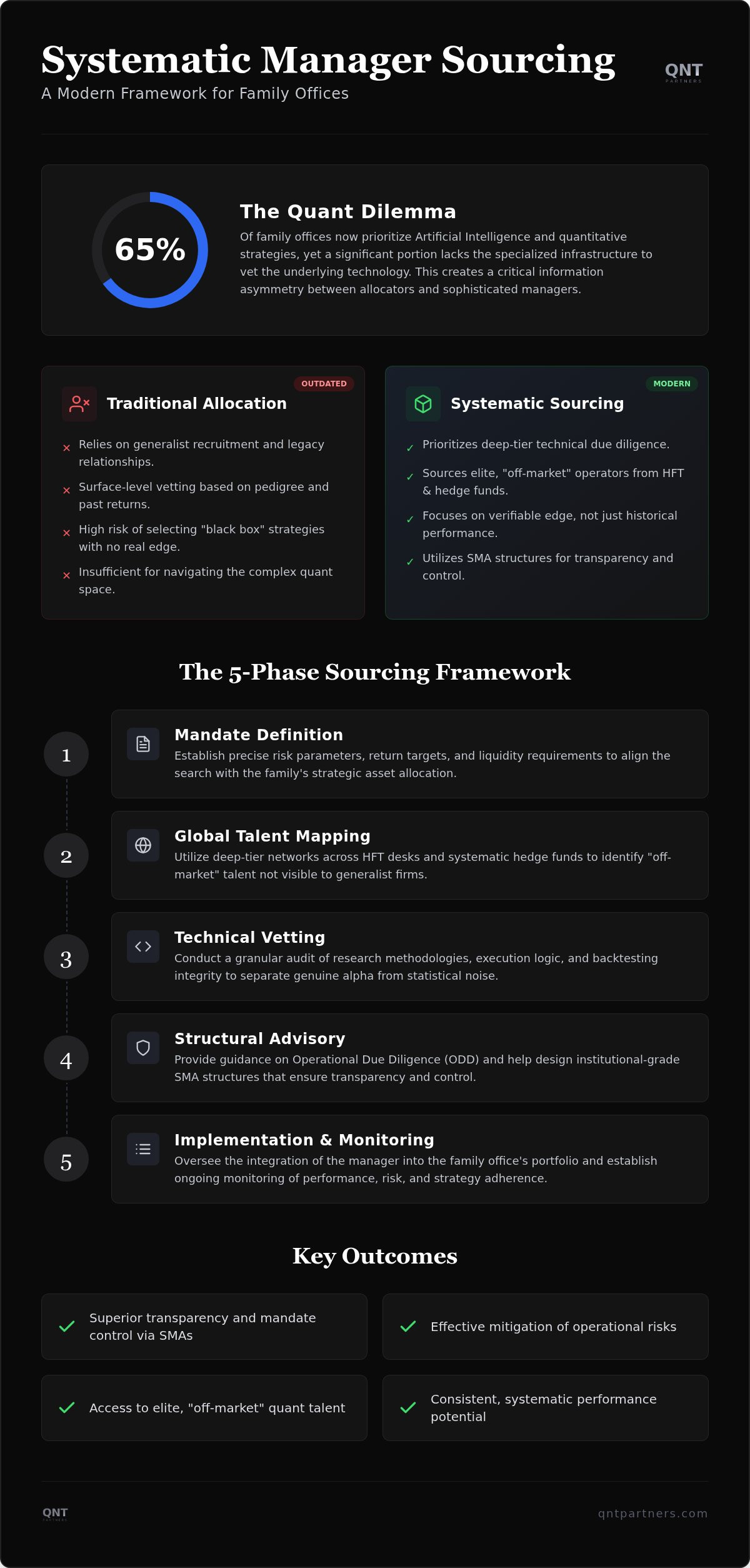
Approximately 65% of family offices now prioritize artificial intelligence within their investment strategies, yet a significant portion of these firms lack the specialized infrastructure to vet the underlying technology. While the pursuit of non-correlated alpha is a logical response to global volatility, the high failure rate of generic selections suggests that standard due diligence is often insufficient for the quant space. You understand that the primary challenge isn't a lack of capital, but rather the deep information asymmetry that exists between sophisticated systematic managers and traditional allocators.
A strategic manager search for family offices bridges this gap by transitioning the focus from purchasing off-the-shelf products to sourcing elite operators. In this article, you'll discover how the world's most discerning offices leverage specialized sourcing and SMA structures to access institutional-grade strategies with total transparency. We'll detail the shift toward rigorous technical due diligence, the benefits of customized mandates, and the methodology required to identify managers who can deliver consistent, systematic performance in increasingly complex markets.
Key Takeaways
- Traditional allocation models are increasingly insufficient for capturing systematic alpha, necessitating a transition from purchasing generic products to sourcing specialized technical operators.
- A rigorous manager search for family offices must prioritize deep-tier technical due diligence to effectively distinguish genuine quantitative edge from market noise or temporary luck.
- Implementing institutional-grade SMA structures provides family offices with superior transparency and mandate control, effectively mitigating the operational risks inherent in boutique quant strategies.
- Accessing elite, "off-market" talent from high-frequency trading desks and systematic hedge funds requires a strategic partner with direct, operator-level roots in the quantitative industry.
The Evolution of Family Office Allocation: Beyond Traditional Search
The traditional mandate for capital preservation is undergoing a fundamental recalibration. As global markets exhibit higher correlations and increased volatility, sophisticated allocators are moving away from passive benchmarks in favor of active, systematic alpha generation. This shift has birthed the "Institutional Family Office," a structure that mirrors the operational rigor of a top-tier hedge fund while maintaining the privacy and flexibility inherent in what is a family office and its core functions.
This evolution demands a more surgical approach to talent acquisition. Traditional networking and legacy relationships no longer suffice when the objective is to secure non-correlated returns through complex quantitative strategies. The information asymmetry in the quant space remains high; managers often obscure the reality of their "edge" behind proprietary black boxes. Consequently, the manager search for family offices must now function as a technical filtration system rather than a standard recruitment process.
The Limitations of Generalist Recruitment
Generalist search firms often lack the technical depth required to audit a systematic manager's process. They rely on pedigree and historical performance figures that may be the result of market beta rather than genuine alpha. Without the ability to evaluate technical backtesting, signal decay, or execution infrastructure, these firms risk placing managers who cannot replicate past successes in new environments. This surface-level vetting creates a dangerous gap between expected and realized performance.
There's also the significant risk of talent leakage. The most capable quantitative researchers and portfolio managers are increasingly avoiding large, bureaucratic institutions. They prefer boutique, high-transparency SMA structures where they can operate with greater autonomy and direct alignment. Identifying these "off-market" operators requires an insider's perspective that generalist recruiters simply don't possess.
Defining the Modern Manager Search Mandate
The search mandate has expanded beyond traditional leadership roles like the CEO or CFO. We see a rising demand for specialized Chief Investment Officers and Heads of Quant who can integrate advanced technology infrastructure directly into the investment search process. These leaders don't just manage portfolios; they manage data pipelines and machine learning models. They're the architects of the family office’s technical edge.
Successful manager search for family offices now requires a partner who functions as an operator. This means moving beyond the resume to assess the robustness of a manager's research framework and their ability to scale technical operations. By prioritizing technical mastery over marketing flair, family offices can secure the specialized talent necessary to navigate the complexities of modern systematic trading.
A Framework for Systematic Manager Search and SMA Sourcing
The trend of professionalizing family offices has necessitated a move toward institutional-grade sourcing frameworks. When seeking systematic alpha, the process must be as rigorous as the strategies themselves. A structured approach ensures that capital isn't just deployed, but strategically matched with managers who possess a verifiable technical edge. This framework moves beyond the qualitative "gut feel" of traditional recruitment, focusing instead on data-driven filtration and operational robustness.
Our methodology for executing a manager search for family offices follows a deliberate five-phase progression:
- Phase 1: Mandate Definition. Establishing precise risk parameters, return targets, and liquidity requirements to align the search with the family’s broader strategic asset allocation.
- Phase 2: Global Talent Mapping. Utilizing deep-tier networks across high-frequency trading (HFT) desks and systematic hedge funds to identify "off-market" talent not visible to generalist firms.
- Phase 3: Technical Vetting. Conducting a granular audit of research methodologies, execution logic, and backtesting integrity to separate genuine alpha from statistical noise.
- Phase 4: Structural Advisory. Providing guidance on Operational Due Diligence (ODD) and the legal architecture of Separately Managed Accounts (SMAs).
- Phase 5: Deployment and Monitoring. Facilitating seamless onboarding and establishing performance attribution protocols to ensure ongoing mandate compliance.
Technical Vetting: The Quant Advantage
In the systematic space, marketing materials often mask the risk of "overfitting," where a strategy is tuned too closely to historical data and fails in live markets. A sophisticated manager search for family offices must include a peer-to-peer technical review. This involves evaluating the manager’s research pipeline, their use of AI and machine learning, and the stability of their technological infrastructure. For high-turnover strategies, we examine low-latency execution capabilities to ensure that slippage won't erode the projected alpha.
The SMA Advantage for Family Offices
While traditional fund-of-funds structures offer diversification, they often lack transparency and carry layers of unnecessary fees. The shift toward SMAs allows family offices to maintain direct ownership of their assets while benefiting from the manager’s intellectual property. This structure provides total visibility into daily holdings and allows for the customization of mandates to meet specific tax or ESG requirements. By sourcing managers for an SMA, a family office gains the control of an internal trading desk without the overhead of building one. If you're looking to refine your allocation strategy, our team can help you source specialized managers tailored to your specific risk profile.
Case Study: Transitioning a Multi-Generational Family Office to Systematic Alpha
A multi-generational family office managing over $1.1 billion in assets recently reached a critical inflection point. Despite a portfolio diversified across traditional asset classes, a deep audit revealed that their "diversification" was an illusion. During periods of market stress, their equity, real estate, and private equity holdings exhibited high correlations, leading to significant drawdowns. They required a total recalibration of their risk profile, moving away from long-only exposure toward a market-neutral systematic framework.
The family's leadership recognized that internalizing this capability required more than just capital; it required a fundamental shift in how they approached talent. They didn't just need a fund; they needed a specialized team capable of executing high-frequency and mid-frequency strategies with total transparency. This transition served as the catalyst for a comprehensive manager search for family offices to identify a dedicated quant pod.
Identifying the Strategic Gap
The first step involved identifying hidden correlations that traditional reporting had failed to capture. We determined that the office needed a Head of Systematic Investing to act as the technical bridge between the family and the external managers. This role was critical for overseeing the technology stack and ensuring that the selected strategies remained within strict risk bounds. By applying a systematic framework for manager selection, we focused on the technical facts of the strategies rather than the marketing narratives often presented by large hedge funds.
The criteria for the search were uncompromising. We prioritized team stability, the robustness of their backtesting environment, and the scalability of their low-latency execution infrastructure. The goal was to find an operator who could deliver consistent, non-correlated returns without the "key man" risk often found in boutique quant shops.
Execution and Manager Selection
QNT Partners leveraged its deep network within high-frequency trading (HFT) desks and systematic hedge funds to source talent that isn't typically visible to the broader market. We presented three distinct pods: one focused on short-term HFT arbitrage and two specialized in mid-frequency statistical arbitrage. Our role as an "operator-led" firm allowed us to conduct the final technical interviews, auditing the managers' code and research pipelines alongside the family's new Head of Systematic Investing.
The outcome was the successful allocation to a market-neutral quant team via a bespoke SMA structure. This arrangement provided the family office with 24/7 transparency and direct control over their assets. By avoiding the opaque fund-of-funds model, the office achieved a more efficient fee structure and a higher degree of mandate alignment. This strategic manager search for family offices transformed a legacy portfolio into a modern, institutional-grade systematic engine.
Identifying Alpha in the Noise: Key Selection Criteria for 2026
As we approach 2026, the threshold for defining institutional-grade alpha has shifted. Performance attribution is no longer just about the bottom line; it's about the decomposition of returns into luck, beta, and genuine edge. For a manager search for family offices to be successful, it must identify managers who can demonstrate that their returns aren't merely the result of a specific market regime or a temporary beta tailwind. We prioritize managers with a durable, repeatable research process that can withstand the increased volatility and shifting correlations of the modern macro environment.
Scalability within an SMA framework is equally critical. A strategy that performs well in a small, commingled fund may suffer from significant slippage when moved to a dedicated account with specific liquidity constraints. We examine the capacity limits of each strategy and the robustness of the manager's execution algorithms. Furthermore, we assess team stability to mitigate "key man" risk. In boutique quant environments, the departure of a lead researcher can often lead to strategy drift or total failure; therefore, we look for firms that have institutionalized their intellectual property through collaborative research pipelines.
Vetting AI and ML Specialists
The marketplace is currently saturated with "AI-enabled" managers who use large language models for surface-level data processing. Our vetting process focuses on identifying "AI-native" operators who have integrated machine learning into the core of their alpha generation engine. Data hygiene is the primary differentiator here. We audit the manager's data sourcing, cleaning protocols, and their ability to handle proprietary or alternative datasets. Recruiting for the intersection of data science and financial engineering requires a partner who understands the technical nuances of neural networks and reinforcement learning in a trading context.
Operational Due Diligence (ODD) Essentials
Operational Due Diligence must extend beyond a simple review of financial statements. It requires a deep-tier audit of the manager's technology stack and execution platform. For high-frequency or high-turnover strategies, low-latency capabilities and co-location infrastructure are non-negotiable. Risk management protocols must also evolve beyond standard Value at Risk (VaR) models to include rigorous stress testing for liquidity shocks and tail-risk events. Understanding these technical requirements is essential when Scaling High-Performance Quantitative Trading Teams within a family office structure.
Identifying true systematic edge requires a level of technical scrutiny that traditional recruiters cannot provide. If you are seeking to audit the technical maturity of your prospective managers, engage our specialist search team to ensure your manager search for family offices meets the highest institutional standards.
QNT Partners: Elite Manager Search and Capital Advisory
QNT Partners operates at the specific intersection of quantitative research recruitment and institutional capital advisory. Our firm was founded by former industry operators who have directly managed technical trading desks and understand the granular requirements of systematic alpha. This background allows us to move beyond the surface-level vetting typical of generalist firms, providing a peer-to-peer relationship with both the allocator and the investment manager. We specialize in identifying "off-market" talent from high-frequency trading desks and elite systematic hedge funds, ensuring our clients access strategies that are rarely available through traditional channels.
Our advisory services extend from initial talent acquisition to the specialized structuring of capital raising via SMAs. We understand that for family offices, discretion and professional gravity aren't just preferences; they're operational requirements. By maintaining a highly selective client list, we ensure that every manager search for family offices receives the technical scrutiny and strategic attention it demands. This commitment to quality over volume allows us to bridge the information asymmetry that often plagues the quantitative investment space, ensuring that your capital is matched with genuine technical mastery.
Why a Boutique Approach Wins
Large recruitment firms often suffer from a "supermarket" mentality, where the focus on volume dilutes the technical precision of the search. A boutique approach avoids this trap by offering direct access to senior partners who possess hands-on trading experience. We don't just provide resumes; we provide strategic talent advisory that considers the specific nuances of generational wealth cycles. This ensures that the investment teams we build are as resilient as the capital they manage, with incentives structured to ensure long-term alignment between the family and the manager.
Next Steps for Your Family Office
The first step in professionalizing your systematic allocation is a thorough benchmarking of your current investment team against institutional standards. We help you identify gaps in your technology stack, research methodologies, and risk protocols. Once the baseline is established, we facilitate a confidential discovery call to define your manager sourcing mandate. This methodical approach ensures that your office is positioned to capture elite alpha without compromising on operational control or transparency. To begin this process, you can Speak with a Partner at QNT Partners.
Securing Your Systematic Edge
The transition toward an institutional-grade systematic portfolio is no longer a luxury for family offices; it's a structural necessity in a high-volatility regime. By moving beyond traditional fund structures and embracing the transparency of Separately Managed Accounts (SMAs), you gain the control required to navigate complex market correlations. A successful manager search for family offices must prioritize technical vetting of AI and ML stacks to separate genuine alpha from statistical noise. This process ensures that your allocation is driven by repeatable research rather than temporary market luck or hidden beta.
QNT Partners provides the operator-led advisory needed to bridge the gap between sophisticated managers and generational wealth. Our deep roots in HFT and quantitative research ensure that your capital is matched with elite, non-obvious talent through a global boutique network. We invite you to Consult our Specialists on Manager Search & SMA Sourcing to begin benchmarking your current team or sourcing your next technical pod. We look forward to helping you build a resilient, alpha-driven future that protects and grows your family's legacy through technical mastery.
Frequently Asked Questions
What is the difference between executive search and manager search for a family office?
Executive search typically focuses on leadership roles like CEO or COO, prioritizing management experience and cultural fit. Manager search for family offices is a technical endeavor focused on sourcing investment operators who can execute specific systematic strategies. While executive search evaluates people, manager search evaluates the intersection of talent, strategy, and technology infrastructure. It requires a deep understanding of alpha generation and risk management rather than just organizational leadership.
Why are Separately Managed Accounts (SMAs) preferred over comingled funds?
Separately Managed Accounts (SMAs) provide family offices with direct asset ownership, total transparency, and granular control over investment mandates. Unlike comingled funds, where capital is pooled and strategies are rigid, SMAs allow for customization to meet specific tax and liquidity requirements. This structure eliminates the "black box" risk of traditional hedge funds. It ensures that the family office has real-time visibility into holdings and performance attribution without the burden of excessive fee layers.
How does QNT Partners vet the technical capabilities of a quant manager?
We employ a peer-to-peer technical audit that examines research pipelines, backtesting integrity, and execution logic. Our operators review the manager's code and data hygiene protocols to distinguish between genuine systematic edge and statistical overfitting. We also assess the stability of the technology stack, focusing on low-latency capabilities for high-frequency strategies. This rigorous process ensures that the managers we present possess the technical maturity required for institutional-grade portfolios.
What is the typical timeline for a specialized manager search?
A specialized manager search typically spans twelve to sixteen weeks from mandate definition to final selection. The initial mapping and technical vetting phases usually require six to eight weeks of intensive research. This is followed by deep-dive interviews and operational due diligence. While the timeline can vary based on the complexity of the strategy or specific niche requirements, we prioritize precision and thoroughness to ensure long-term alignment between the family and the manager.
Can QNT Partners help source managers for specific niches like AI or HFT?
Yes, QNT Partners specializes in sourcing elite talent for niche strategies including high-frequency trading (HFT) and AI-native investment programs. We leverage an extensive network within proprietary trading firms and systematic hedge funds to identify operators with proven expertise in reinforcement learning and neural networks. Our operator-led background allows us to vet these technical specialists at a level that generalist firms cannot match, ensuring access to non-obvious, "off-market" managers.
How do you ensure confidentiality when searching for family office leaders?
Discretion is the cornerstone of our family office practice. We utilize blinded profiles and secure communication protocols to protect the identity of both the family office and the prospective managers during the initial stages. Our firm operates within a rarified space where reputation is paramount; therefore, we only disclose sensitive information once a mutual interest and a non-disclosure agreement are firmly in place. This methodical approach maintains the professional gravity required for high-stakes talent movements.
What role does operational due diligence play in the manager search process?
Operational Due Diligence (ODD) is the final layer of protection, verifying that the manager's technical infrastructure and risk protocols are robust. It involves auditing the execution platform, cybersecurity measures, and trade reconciliation processes. By conducting a thorough ODD, we ensure that the strategy is not only profitable but also operationally sound within an SMA framework. This reduces the risk of tail events or operational failures that could jeopardize the family's capital.
Do you provide benchmarking for existing family office investment teams?
We provide comprehensive benchmarking services to evaluate your current investment team against institutional standards. This process includes auditing your technical research capabilities, risk management protocols, and technology infrastructure. By identifying gaps in your current setup, we help you determine whether to upskill your existing talent or initiate a targeted manager search for family offices to bring in new expertise. This ensures your office remains competitive in an increasingly data-driven investment landscape.